The U.S. has some great blue-chip stocks trading in their market. These large-cap companies have excellent fundamentals, with strong business models, long histories of share price appreciation, solid dividend growth, and good competitive advantages.
Canadian investors should strongly consider making these blue-chip stocks the backbone of the U.S. equity portion of their portfolio. However, choosing which one to buy and hold can be tricky. Keeping up with the news, re-balancing, and staying on top of earnings reports can be tiring.
Fortunately, there are a variety of exchange-traded funds (ETFs) out there that take the hassle out of stock picking. For a very low fee and zero effort, you can own an ETF that holds 30 of the U.S.’s largest, most traded stocks.

Image source: Getty Images
Which index to track?
When we think of the U.S. market, we often default to either the S&P 500 Index or the NASDAQ 100 Index. Both of these indexes are very popular and hold some of the best-performing U.S. companies. However, they have both become tech and growth heavy in recent years.
There is an alternative in the Dow Jones Industrial Average (DJIA). First published in 1896 and initially comprising of 12 companies, the DJIA as evolved into the most recognizable stock indicator in the world and the most widely quoted indicator of U.S. stock market activity.
Currently, the DJIA holds a total of 30 stocks, all leaders in their respective industries with the common trait of sustained earnings performance over a significant period of time. The DJIA is a price-weighted stock index, meaning that the component stocks are held in proportions based on their price and not market caps, like other indexes.
Current notable underlying stocks include Walmart, Walt Disney, Coca-Cola, Home Depot, Microsoft, Goldman Sachs, McDonald’s, Visa, Boeing, Apple, Johnson & Johnson, 3M, and JP Morgan Chase & Co, representing a diverse, balanced mix of sectors.
How do we buy the Dow?
Buying the DJIA usually requires converting CAD to USD and buying a U.S. ETF. If you’re not familiar with Norbert’s Gambit, the currency conversion costs could be expensive. However, Canadian fund managers like BMO Global Asset Management have come out with ETFs that track the DJIA in CAD.
Our best candidate here is BMO Dow Jones Industrial Average Hedged to CAD Index ETF (TSX:ZDJ). ZDJ seeks to replicate the performance of the DJA, net of expenses, and with the U.S. dollar currency exposure is hedged back to the Canadian dollar.
ZDJ will cost you a management expense ratio (MER) of 0.26% to hold, which is typical for a U.S. equity index ETF in Canada. Being comprised of blue-chip companies, ZDJ also pays a respectable dividend yield of 1.50%. This yield already reflects a 15% reduction due to foreign withholding taxes on U.S. assets for Canadian investors.
ZDJ is currency hedged using forex derivatives. Theoretically, this means that ZDJ’s value will not be affected by fluctuations of the CAD-USD and should track the DJIA closely. In practice, the nature of the futures contracts used and the imperfect way they are rolled forwards introduces tracking error over time.
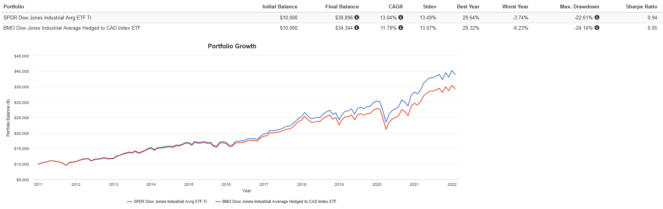
We see that since inception, ZDJ has tracked the DJIA closely but underperformed by over 1% CAGR. Over the long period, currency fluctuations actually reduce volatility and boost returns. When they are hedged away, you lose that benefit and incur additional tracking error, causing underperformance over the long term.
The Foolish takeaway
If you want an absolutely hands-off approach for your U.S. equity portfolio, ZDJ is the way to go. For a small annual fee, you get the performance of the top 30 stocks in the U.S. market.
You’ll never have to worry about rebalancing or monitoring the holdings, trying to figure out which stock will do well or poorly. Set the dividends on to be auto-reinvested, and enjoy watching your gains compound!