The best way to gain exposure to the equity market is by investing in low-cost exchange-traded funds, or ETFs, which track a particular index. ETFs are ideal investments for those who don’t have the time or expertise to analyze and track individual stocks.
Over the years, ETFs have gained popularity among investors as they are fairly easy to understand and have the potential to generate inflation-beating returns without much effort.
ETFs may cover a variety of asset classes, including stocks, bonds, gold, and even cryptocurrencies. In the case of passive ETFs, they typically track a particular index, such as the S&P 500, where your money will be invested in the 500 largest companies in the U.S.
ETFs eliminate the guesswork from the process of investing in stocks, allowing investors to match the market’s performance after adjusting for expenses and fees.
Further, investing in passive ETFs is a much better strategy compared to mutual funds. First, mutual funds are actively managed and have higher fees and expense ratios, lowering your total returns over time. Second, roughly 90% of large-cap mutual funds have failed to beat the underlying index, making ETF investing all the more crucial. Finally, ETFs are more liquid than mutual funds and can be easily traded on an exchange.
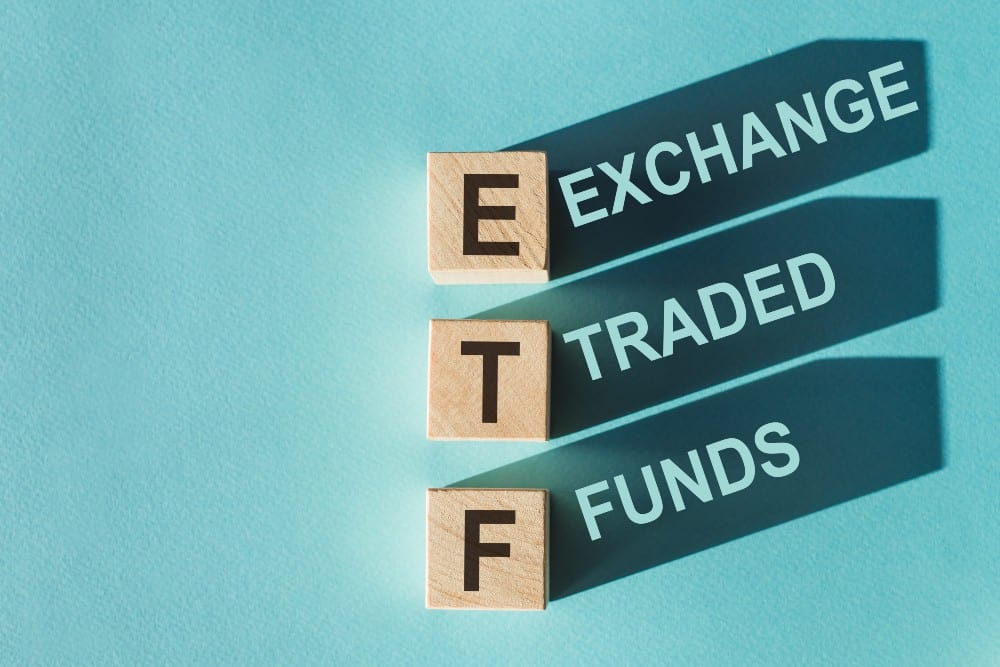
Image source: Getty Images
Where to invest $1,000 right now?
Canadian investors can consider gaining exposure to the U.S. markets, which is also the world’s largest economy. Several companies south of the border rake in billions of dollars each year, allowing them to grow earnings consistently over time, resulting in outsized gains for shareholders.
For instance, in the last two decades, the TSX index has returned 361% to shareholders after accounting for dividend reinvestments. Comparatively, the S&P 500 index has returned close to 520% since January 2004.
So, while the TSX index has returned 7.9% annually, the S&P 500 has returned 9.55% annually in the last 20 years.
An investment of $1,000 each month in an ETF, which returns 9.55% each year, would increase your portfolio value to $201,000 after 10 years, $722,000 after 20 years, and $2 million after 30 years.
We can see that a disciplined ETF investment strategy can help you achieve financial freedom and accelerate your retirement plans.
So, Canadians looking to invest in the S&P 500 index can consider buying units of iShares Core S&P 500 Index ETF (TSX:XSP).
What is the XSP ETF?
The XSP ETF is a low-cost index fund that tracks the S&P 500. So, the top holdings of the fund include big tech giants such as Apple, Microsoft, Nvidia, Amazon, Alphabet, and Meta.
With $8.8 billion in assets under management, the XSP has a management fee of 0.08% and an expense ratio of 0.09%, which is quite low.
Similar to the S&P 500, you can also enjoy a dividend yield of 1.4%, which can either be withdrawn or reinvested.
The XSP is hedged to the Canadian dollar, shielding investors from fluctuations in exchange rates. In the last 10 years, XSP has returned 10.64% annually, compared to the benchmark returns of 11.08%.