What’s the Best Way to Invest in Stocks Without Any Experience? Start With This Index Fund

Here’s why this all-in-one ETF can be a great way to start investing today.

| More on:

So, you’re ready to start investing – congratulations! Overcoming the inertia and deciding to invest is a crucial step, as it helps you avoid one of the biggest risks out there: the risk of not investing at all.

Now, you face a new decision: where to put your money. There are plenty of options, from safe Guaranteed Investment Certificates (GICs) and Canadian dividend stocks, to the volatile world of cryptocurrencies.

But if you’re a beginner, none of these might be the best fit. Instead, I recommend starting with a globally diversified, low-cost index exchange-traded fund (ETF). Here’s why.
exchange traded funds

Image source: Getty Images

Why an index ETF?

To put it simply, an index ETF is the only investment vehicle that allows you, especially as a beginner, to own a fully diversified portfolio without needing to spend time managing it or acquiring extensive investment knowledge.

How does it achieve this? By purchasing thousands of different stocks from across the globe, covering all market sectors and spanning large, mid, and small-cap sizes, an index ETF offers both growth and dividend returns.

Moreover, these ETFs also invest in bonds issued by governments and corporations worldwide, which vary in maturity. This adds a layer of stability and provides income, enhancing the overall safety of your investments.

Essentially, when you buy shares of an index ETF, you’re acquiring a slice of a vast array of underlying assets. It’s like having a diversified portfolio wrapped up in one single ticker that trades just like a stock – a true portfolio-in-a-box.

Which ETF to buy?

For beginners, I like the BMO Growth ETF (TSX: ZGRO), particularly if you’re comfortable with a higher level of risk and are investing with a long-term horizon, like retirement planning in mind.

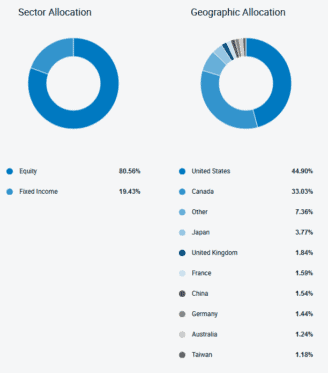
This ETF strategically allocates its portfolio with 80% in stocks and 20% in bonds. It spans a broad range of markets, including Canada, the US, other developed nations, and emerging markets, ensuring thorough diversification.
What’s great is that it’s managed for you; the ETF is rebalanced automatically, so all you need to do is reinvest any dividends, hold your shares, and consider buying more over time to build your investment.

While it isn’t free, it’s certainly cost-effective — its Management Expense Ratio (MER) of 0.20% means you’d pay just $20 annually on a $10,000 investment, which is a small price for the convenience and diversification it offers.


Fool contributor Tony Dong has no position in any of the stocks mentioned. The Motley Fool has no position in any of the stocks mentioned. The Motley Fool has a disclosure policy.

More on Stocks for Beginners

The TFSA is a powerful savings vehicle for Canadians who are saving for retirement.
Stocks for Beginners

I’m Using These 3 Canadian Stocks as My TFSA Cornerstones

These three stocks are perfect anchors for a TFSA portfolio. Here's why they are cornerstones in my TFSA portfolio.

Read more »

Canadian dollars in a magnifying glass
Tech Stocks

BlackBerry Stock Is Up More Than 150%: Here’s the Number I’d Check Before Buying

BlackBerry’s huge 2026 rally has turned its turnaround into an AI-and-QNX growth story, but now it must prove it with…

Read more »

ETFs can contain investments such as stocks
Dividend Stocks

VFV Isn’t a Complete Portfolio: Here’s What Canadian Investors May Be Missing

VFV feels like a complete portfolio, but it’s really a concentrated bet on U.S. large caps and the U.S. dollar.

Read more »

Agricultural harvesting at the last light of day, aerial view.
Dividend Stocks

Potash Power Play: Why This Overlooked Commodity Could Be Canada’s Trump Card

Canada’s potash dominance gives Nutrien a strategic edge as trade tensions rise, making this overlooked commodity worth watching closely.

Read more »

senior man and woman stretch their legs on yoga mats outside
Energy Stocks

Retirees Love Dividends: Here’s the Number That Matters More Than Yield

A tempting 7% yield can vanish fast, so checking the payout ratio helps confirm a dividend is actually sustainable.

Read more »

A red umbrella stands higher than a crowd of black umbrellas.
Dividend Stocks

A 6% Yield Won’t Save a Weak Dividend: I’d Buy This Growing Payout Instead

A lower 3.3% yield can beat a 6% yield over time if the dividend keeps growing, and Manulife is showing…

Read more »

c
Stocks for Beginners

You Don’t Need a Million-Dollar Salary to Build a Million-Dollar TFSA

A million-dollar TFSA is built with ordinary annual contributions and decades of compounding, not an extraordinary salary.

Read more »

infrastructure like highways enables economic growth
Dividend Stocks

A $7,000 TFSA Contribution Could Become $70,000: Here’s the Math

A single $7,000 TFSA contribution can grow into $70,000 over decades if you pair time with a durable grower like…

Read more »