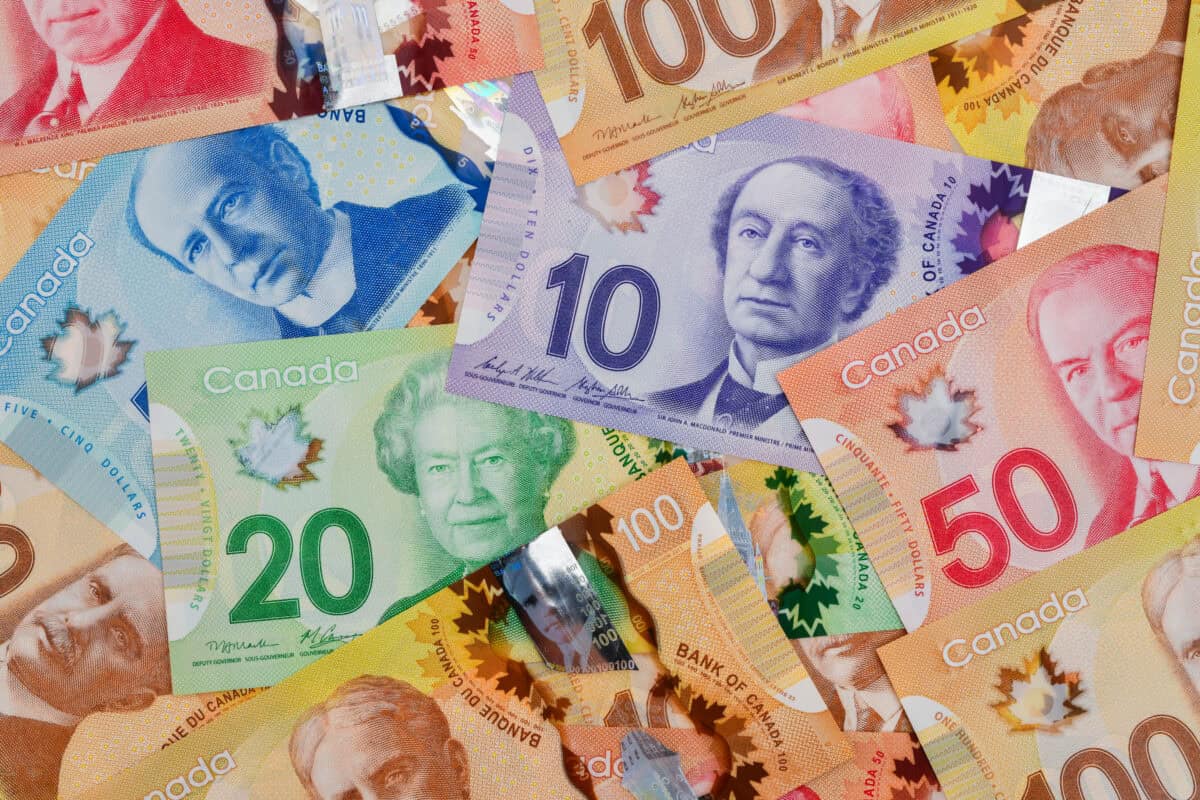
The Canadian dollar has dropped to its 21-year low against the US dollar, with 1 US dollar equal to $1.479 Canadian dollars. The last time the Canadian dollar dropped this low was in April 2003. Economists are expecting more drops in the Canadian dollar as the U.S. government imposes a 25% tariff on the Canadian economy.
Source: Getty Images
The drop in the Canadian dollar
Exports to the U.S. account for about a fifth of Canada’s gross domestic product (GDP). And a year-long tariff could reduce Canada’s GDP growth to near zero in 2025, leading to a mild recession, according to BMO Capital Markets. Reduced demand for Canadian imports could lower foreign currency inflows and weaken the Canadian dollar further.
Canada’s retaliation with tariffs on U.S. imports to Canada and President Justin Trudeau’s urge to Canadians to avoid using American-made goods could make goods more expensive. Tariffs make things expensive and slow growth. BMO expects the Bank of Canada to accelerate its interest rate cuts and bring the rate down to 1.5% from the current 3% to support growth. This could further pull down the Canadian dollar. Toronto Dominion economists expect the CAD to fall as low as US$0.65 from US$0.685 as of February 3, 2025.
How investors should think about the falling Canadian dollar
The economic environment looks gloomy and the currency market is bearish. However, there is always an investing opportunity in every situation if you look at the right place. For instance, the falling Canadian dollar presents a two-way opportunity.
A TSX stock that earns in US dollars
The first opportunity is in companies that earn in US dollars and report in Canadian dollars. These companies have strong U.S. operations. As they are already operating in the U.S., the export impact is minimal.
Slate Grocery REIT (TSX: SGR.UN) has 116 properties in 23 states of the United States. The REIT earns 46% of its rental income from supermarkets and grocery stores that are resilient to economic downturns. The REIT earns rent in U.S. dollars and gives dividends to Canadians in CAD.
The REIT’s unit price has fallen 2.6% on the news of tariffs, creating an opportunity to buy and lock in an 8.8% yield.
The REIT gives dividends monthly. As the Canadian dollar falls throughout the year, the foreign exchange conversion could increase the monthly distributions from the REIT. As an alternative investment in a defensive sector of grocery, Slate Grocery REIT could give you regular passive income amid uncertain times.
Investing in safe haven stocks
Another investing opportunity could come from the yellow metal. For ages, gold has outperformed the market at times of uncertainty. The tariff on Canada and China is just the beginning. Even if Canada and the United States come to a trade agreement, there will always be a risk of aggressive policies.
The gold price rises when the U.S. dollar falls. However, in this case, the U.S. dollar is rising. If the trade war escalates to a global trade war, central banks worldwide would accumulate more gold. You could benefit from investing in Barrick Gold (TSX: ABX), Canada’s largest gold mining company. It reports its earnings in US dollars. An increase in demand for gold could drive the gold price, enabling Barrick Gold to command a higher price for its inventory.
Final takeaway
As an investor, you could make the most of the current turmoil. It is time to rebalance your portfolio by booking profits in oil stocks and investing in the above stocks.