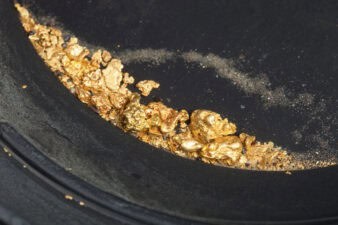
I own gold and silver, and yes, some of it is physical. Economically, though, I probably would have been better off buying it through a fund inside a registered account like a Tax-Free Savings Account (TFSA).
When you buy precious metals from a dealer, you lose money immediately due to the spread. In my case, it was roughly 1.5% on the way in, and if I turned around and sold it right back, I would have lost another 1.5%. That spread is how dealers make money. Better dealers charge less, worse ones charge more, but either way, you get dinged.
Then there’s storage. You need a safe, you may need to update your home insurance, and suddenly the “simple” act of owning gold or silver comes with friction and ongoing costs. None of that is a dealbreaker. There is still something uniquely satisfying about holding physical metal in your own hands, under your own name, with no counterparty telling you what to do.
But if your goal is diversification rather than doomsday preparation, funds make a lot more sense. Gold and silver have historically held up during certain market stress periods, including 2022 and again more recently. If you want that exposure inside a brokerage account, my preferred route is a physically backed fund. For Canadian investors, two long-standing options from Sprott stand out.

Source: Getty Images
The best gold fund
The first pick is the Sprott Physical Gold Trust (TSX: PHYS). Despite what many people assume, this is not an exchange-traded fund (ETF). It is a closed-end fund.
ETFs can create and redeem shares on demand, which keeps their market price tightly aligned with net asset value (NAV). Closed-end funds do not work that way. They have a fixed pool of shares unless a secondary offering is issued.
Because of that structure, PHYS can trade at a premium or a discount to its NAV. The price you see in your brokerage account may be higher or lower than the value of the gold it actually holds.
At the moment, PHYS trades at roughly a 1.65% discount to NAV. That means you are buying gold for less than its underlying value, although there is no guarantee that discount ever narrows.
Beyond that pricing mechanic, the trust is straightforward. It holds about $16 billion in assets, all backed by physical gold. As of December 17, the trust reported holding 3,687,798 ounces of gold.
When you buy shares, you are purchasing fractional ownership of that pile of metal. The management expense ratio is 0.39%, which works out to about $39 per year on a $10,000 investment. That is very typical for a physically backed precious metals fund.
The best silver fund
For silver exposure, the natural companion is the Sprott Physical Silver Trust (TSX: PSLV). Sprott specializes in commodity-focused funds, and this trust mirrors the structure of PHYS, but with silver instead of gold.
At present, PSLV holds about $13.82B in assets, corresponding to roughly 207,508,993 ounces of silver held in trust. Like PHYS, investors get fractional ownership of that silver rather than exposure through derivatives.
PSLV currently trades at a steeper discount to NAV than its gold counterpart, around 3.7%. That can be attractive if you want silver exposure and are comfortable with the possibility that the discount persists.
The tradeoff is cost. PSLV has a management expense ratio of 0.57%, which is higher than PHYS, but still fairly standard for silver funds in Canada, even when compared to newer ETFs.