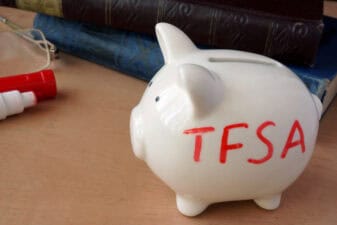
If you want to retire on time, you should hold some of your investments in a Tax-Free Savings Account (TFSA). Letting you hold and withdraw investments tax-free, TFSAs give you considerable savings power. If you earn $50,000 in Registered Retirement Savings Plan (RRSP) income and have a 50% marginal tax rate, then the income gets cut in half upon withdrawal. That exact same income withdrawn from a TFSA is not taxed at all! So, clearly, all Canadians should be investing in a TFSA. In this article, I’ll tackle the question of how much money you need in your TFSA to comfortably retire.
Source: Getty Images
No one-size-fits-all solution
Right off the bat, it’s important to note that there is no one answer to the question of how much a Canadian needs in a TFSA to retire. It depends on living expenses, tax rates, and dependents. However, it is possible to develop profiles of some typical Canadians and estimate much TFSA income they’d need to retire. In the ensuing sections, I will come up with such estimates for two fictitious Canadians: Harry and Sally.
Harry: The married high earner
Harry is a high earner who mainly invests in dividend stocks like Fortis (TSX: FTS) as well as exchange-traded funds (ETFs). Because he invests all of his money in RRSPs and TFSAs, Harry does not need to worry about investment taxes.
Harry rents a condo in Toronto for $5,000 per month. He and his wife earn $500,000 per year combined ($250,000 after tax). They have three children, for whom they spend $2,000 per month (so $6,000 in total). Their food, cellular, internet, and utility bills come to $1,500 per month. They also spend about $10,000 per year on travel and entertainment. These expenses sum to $160,000 per year. For Harry to continue such spending in retirement, he would need $4.485 million in his TFSA. This amount can’t be contributed to a TFSA without prior gains, but Harry made large investment gains in the past. Here’s the math showing why he needs $4.485 million in TFSA investments to retire.
| COMPANY | RECENT PRICE | NUMBER OF SHARES | DIVIDEND | TOTAL PAYOUT | FREQUENCY |
| Fortis | $71.79 | 62,481 | $0.64 per quarter ($2.56 per year) | $39,988 per quarter ($159,951 per year) | Quarterly |
Sally: The single retiree
Sally is a single retiree who lives in Newfoundland. She spends $1,500 a month on rent, utilities, cell, and internet combined. She has no dependents. Her groceries cost her $450 per month. In addition to that, she takes one $5,000 vacation per year and spends a further $5,000 on miscellaneous entertainment activities. These amounts add up to $38,400; so, based on the previous table, if Sally is invested in Fortis stock, she needs $1.076 million in her TFSA to retire on investment income alone.
Takeaways
From the two fictitious but realistic Canadians we profiled, we can come up with some conclusions about how much you would need in a TFSA to retire:
- The amount of investments you’d need to retire is significant, even with the TFSA’s famed tax efficiency.
- The amount is also well in excess of the maximum accumulated contribution room for 2026 ($109,000).
- Most Canadians need a mix of TFSAs, RRSPs, Canada Pension Plan, and Old Age Security to retire.
Put simply, it’s not likely that you can retire on a TFSA alone in 2026. The only way it could happen would be if you realized huge, market-beating gains. However, new TFSA room is added each and every year. With time, diligent saving and shrewd investing, you could make it work.