If you’re a Canadian investor, you likely spend a fair amount of time at Canadian Tire (TSX:CTC.A). But while you’re picking up wiper blades or a new air fryer, you might be missing out on a much better deal: owning the building you’re standing in through a generous Real Estate Investment Trust (REIT) that grows and enriches your Tax-Free Savings Account’s (TFSA) monthly passive income.
CT Real Estate Investment Trust (TSX:CRT.UN) is the landlord that owns most of the real estate housing Canadian Tire outlets. The trust, a carve-out of the retailer’s property portfolio, remains a development partner to the specialty retail giant as it expands its footprint across Canada. This explains CT REIT’s consistent portfolio growth, which supports rising monthly dividends, currently yielding 5.5% annually.
The REIT recently dropped its fourth-quarter 2025 (Q4 2025) financial and operating results, and for passive income-seeking investors, the report was a perfect set of cash flow numbers and strategic developments.

Source: Getty Images
CT REIT’s stellar Q4 2025 earnings: Fortress-level monthly distribution stability
CT REIT’s latest year-end report showcased why it’s the gold standard for monthly passive income. The trust retains full occupancy. It ended 2025 with an incredible 99.5% occupancy rate, an increase from 99.1% at the end of 2023. The portfolio has remained resilient through economic cycles. Its main tenant, CTC, comprises 90.7% of the trust’s base rent. When your main tenant is one of Canada’s most iconic retailers with an investment-grade balance sheet, the rent cheques usually arrive on time.
The REIT increased its rentable area by 893,000 square feet of new gross leasable area (GLA) during the past year. Property revenue increased for the 12th consecutive year since its IPO. Operating income keeps growing, and its adjusted funds from operations (AFFO) per unit increased by 2.9% during the past year. AFFO measures the sustainable distributable cash flow from REIT operations, and CT REIT is generating more of it as it maintains full occupancy while expanding its portfolio’s total leasable area.
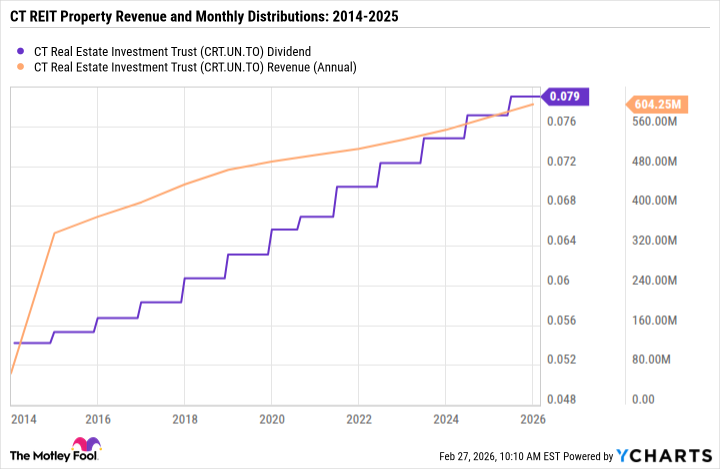
CRT.UN Dividend data by YCharts
CT REIT’s monthly distribution policy is conservative, yet generous. The trust’s AFFO payout ratio for 2025 sat comfortably at 73.5%. While other higher-yield Canadian REITs might sweat with payout ratios near 95–100%, CT REIT has a massive cash flow buffer. This has allowed it to hike distributions for 12 consecutive years. It’s likely to keep raising monthly payouts well into the foreseeable future, increasing your TFSA’s monthly passive income generation capacity.
Why REITs are perfect for the TFSA
In a standard non-registered investment account, REITs are a tax-reporting headache. Because CT REIT is a trust, its monthly cash payout is a blended distribution that is generally taxable at your average personal income rates.
In a taxable account, you have to track components like:
- Other income: This is taxed at your high marginal rate. This component exceeded 95% of CT REIT’s distributions for the first time in 2024.
- Return of Capital (ROC): Tax-deferred, but it lowers your Adjusted Cost Base (ACB). You’ll eventually pay the CRA in the form of a larger capital gain when you sell the position.
- Capital gains: Only 50% taxable, but another line item to track.
Component weights will vary each year. Tracking these tax items on every REIT (or income trust) distribution into your non-registered account every tax season can be laborious.
By tucking CT REIT into your TFSA, you effectively blindfold the CRA. You won’t care about ROC. You won’t care about cost basis tracking. And you won’t care about March 31st T3 slips. Every cent of that 5.5% yield ($0.07903 per unit every month) lands in your account as pure, spendable cash.
An undervalued TFSA monthly income-producing asset
At a recent price of $17.16, CT REIT units traded at a 7.4% discount to their most recent net asset value of $18.53 as of December 31, 2025.
If we include the trust’s growing funds from operations (FFO), CT REIT’s forward price-to-FFO (P/FFO) multiple of 12.4 times appears undervalued for a stable growth, fully occupied retail property portfolio with a low debt ratio of 39.8%. Multiples between 13 and 15 times would still be fair for this high-quality, monthly income-producing REIT asset.
The Foolish bottom line
For TFSA investors building a retirement income portfolio, CT REIT is the ultimate “set it and forget it” monthly income machine. It offers a 5.5% yield, a 12-year streak of annual distribution increases, and a payout that is bulletproofed by a 73% payout ratio, all without tax complexity.