If you have some cash sitting on the sidelines, market volatility in 2026 could provide better opportunities for building passive-income portfolios more affordably. With the right strategy, you can turn a $25,000 into a cash-pumping machine that pays you month after month, regardless of what the TSX does next. Using the stability of monthly dividend exchange-traded funds (ETFs), shielding your profits in a Tax-Free Savings Account (TFSA), and letting the power of compounding run wild could be your ticket to making a substantial passive-income stream that pays bills and finances your retirement cravings.
Source: Getty Images
How to make monthly passive income
When building a portfolio designed to make passive income, the biggest mistake investors make is trying to buy 20 different stocks with a small account. With $25,000, trading fees and a lack of diversification may kill your returns. To build a robust passive-income stream, concentrate your cash into assets that offer instant diversification and reliable payouts.
Specifically, you need dividend ETFs (exchange-traded funds). Unlike single companies that usually pay quarterly, a monthly-dividend ETF aggregates those paychecks and spreads them out. This gives you 12 paydays a year instead of just four. For retirees or those covering monthly bills, this frequency is a game-changer. It also accelerates compounding — reinvesting dividends 12 times a year rather than four can significantly balloon your portfolio value over the long term.
First step: The TFSA shield
Before discussing what to buy, let’s discuss where to hold it. The cumulative TFSA contribution room is substantial in 2026. If you invest $25,000 in a TFSA, every single dividend payment, every dollar of that passive income, is yours to keep — forever. No taxes. None. You eliminate tax drag on your portfolio’s growth potential.
Set up a DRIP
To make passive income work better for you, turn on the dividend-reinvestment plan (DRIP). This automatically uses your monthly dividends to buy more shares. Even if you are relying on this income later in retirement, for now, reinvesting that $100 or so a month back into the fund is how you turn $25,000 into $50,000 or more over the next decade.
The core holding: iShares Core MSCI Canadian Quality Dividend Index ETF
So, where do you park the cash? Look no further than iShares Core MSCI Canadian Quality Dividend Index ETF (TSX: XDIV). Managed by BlackRock, the largest ETF issuer globally, the XDIV ETF is a gold standard for conservative investors who want to make growing passive income without losing sleep.
What makes XDIV special is its “quality” mandate. This ETF screens for steady dividend-paying companies with strong balance sheets and low earnings volatility. In plain English, the manager kicks out the risky dividend stocks that might cut their dividends during a downturn. Owning a quality-focused fund like the XDIV means you own the companies that survive and thrive during periods of market turmoil, and keep earning monthly income.
The XDIV’s $4.3 billion portfolio holds 21 high-quality Canadian stocks and pays distributions monthly. Currently, the monthly payout implies a yield of roughly 3.7%, but the magic is in the growth. The ETF has increased its annualized total payouts from $1 in 2018 to $2.11 in 2025.
If you had invested $25,000 in the XDIV ETF five years ago, capital gains alone would have turned that into over $44,000. However, if you had reinvested your monthly dividends along the way (the DRIP effect), you could be sitting on nearly $55,000 today.
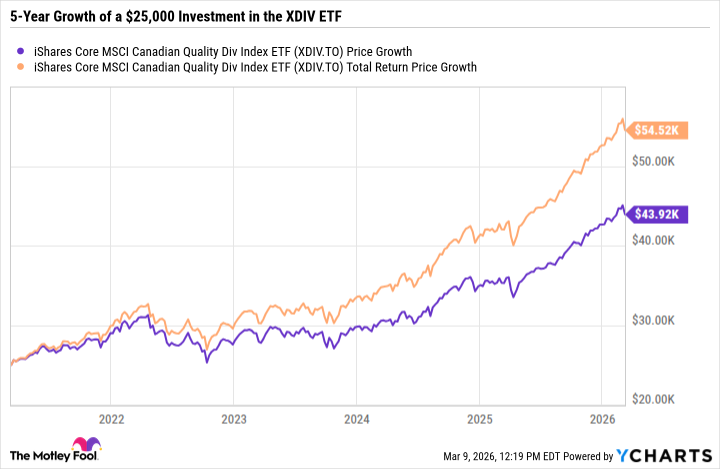
That initial $25,000 investment could be on track to generate approximately $1,650 in annual dividends for 2026 — an implied yield of 6.6% on cost.
Including the dividends on shares bought with reinvested dividends, the passive-income stream grows substantially. Actual returns may differ in the future, but the ETF’s proven income growth strategy remains intact.
With a management expense ratio of just 0.11%, expect to pay roughly $1.10 per year for every $1,000 invested. That leaves more net passive income in your TFSA to compound your total returns.
The Foolish bottom line
Market volatility is your opportunity as high-quality assets go on sale for a limited time. By parking your $25,000 in a monthly dividend ETF, sheltering it in a TFSA, and turning on the DRIP, you would be building a machine that makes passive income for you, automatically, month after month.