The Canadian real estate investment trust (REIT) sector looks like a bargain bin full of high-yield passive-income specials right now. But not all real estate portfolios are created equal. Some retail shopping malls still signs of struggle with empty anchor stores. If you’re looking to put your money to work while you sleep, CT Real Estate Investment Trust (TSX:CRT.UN) is one high-occupancy retail REIT giant quietly churning out reliable and growing monthly cash payouts for investors.
With a fresh $10,000 investment, CT REIT is positioned to pay you $44.26 every single month (or $531.08 annually), and that’s just the starting point of a sustainable dividend growth story that’s already lasted 13 years.

Source: Getty Images
CT REIT’s “all-star tenant” advantage
CT REIT’s growing portfolio of 375 retail properties comprising 31.7 million square feet of gross leasable area (GLA) makes it a passive-income seeker’s fortress during periods of market volatility. This REIT is essentially the landlord to convenience stores giant Canadian Tire, which accounts for over 90% of the REIT’s annual rent income.
Why should CT REIT make you sleep better at night? CT REIT boasts an almost unheard-of 99.5% portfolio occupancy rate while other REITs have to deal with vacancies from departing department stores. Your passive-income provider is anchored by Canadians buying motor oil, hockey gear, and patio furniture. It isn’t betting on a fickle fashion trend. CT REIT’s resilient, necessity-based retail moat pays the bills month after month.
A dividend raise every year? That’s how you beat inflation
Most investors may look at a 5.3% dividend yield and think, “Nice.” But smarter Foolish investors will look at the trajectory of that yield. Since CT REIT’s initial public offering in 2013, CT REIT has grown its rental income and raised its monthly distribution every single year. We’re talking 13 consecutive years of raises — a track record that has boosted the payout by more than 45% since inception.
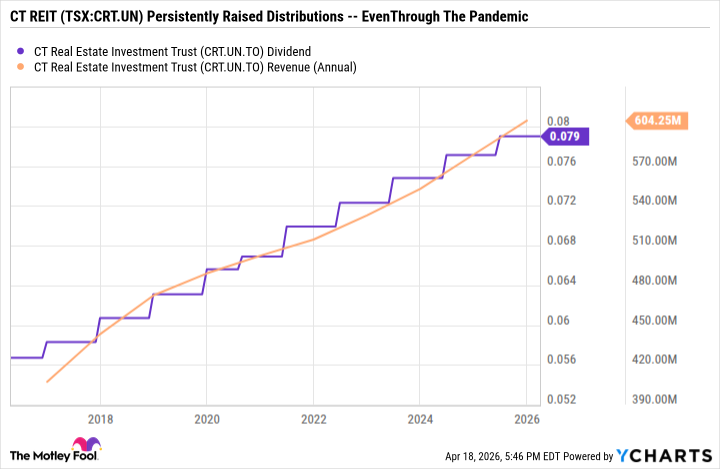
CRT.UN Dividend data by YCharts
As ever persistent inflation keeps grocery bills climbing, the REIT’s consistent distribution raises help your passive-income stream fight back against inflation to retain your purchasing power.
Management delivered a 2.8% bump in adjusted funds from operations (AFFO) per unit in 2025, keeping the payout ratio incredibly safe at an AFFO payout rate of just 73.5%. AFFO measures a REIT’s most sustainable distributable cash flow from operations, and CT REIT’s low payout rate leaves a thick cushion of cash for more development expenditures and — you guessed it — more dividend hikes in 2026 and beyond.
As CT REIT’s CEO Kevin Salsberg noted during an earnings call in February, demand for Canadian retail space is outpacing supply, and CT REIT’s development pipeline — 629,000 square feet of which is 95.2% pre-leased predominantly to Canadian Tire — is pure, low-risk growth that builds more distributable cash flow and supports future distribution raises.
How to turn $10,000 into $44.26 per month passive income
At writing, CT REIT units traded for roughly $17.84 per unit and pay a monthly distribution of $0.07903 per unit. With $10,000 to invest for dependable passive income, the maths to transform the capital into a cash flow is shown in the table below.
| Stock to Buy | Recent Price | Investment | Number of Shares | Dividend | Total Payout | Frequency | Total Annual Income |
| CT REIT (TSX:CRT.UN) | $17.84 | $10,000 | 560 | $0.07903 | $44.26 | Monthly | $531.08 |
A $10,000 investment buys about 560 CRT.UN units that pay $44.26 a month in distributions. That’s $530 a year you didn’t have to clock in to earn. And remember, that’s based on today’s payout. If the trust continues its 13-year streak of distribution increases, that $44.26 monthly paycheck is likely to be higher this time next year.
Should CT REIT investors worry about its “single” tenant concentration risk?
This is perhaps the only question that matters with this monthly dividend stock. Is it dangerous to have all your dividend eggs in the Canadian Tire basket? It would be terrifying if Canadian Tire was on financially or operationally shaky ground. But the chief tenant is thriving as its True North reset takes shape. The retailer carries an investment-grade BBB credit rating from Morningstar DBRS and its stores remain the go-to destination for the stuff Canadians actually need. Canadian Tire isn’t likely to struggle with paying its monthly rentals any time soon.