Earning a steady stream of monthly paycheques from your investment portfolio is a preferable outcome for passive-income investors. But managing individual dividend-paying stocks, bonds, or preferred shares can quickly become a chore, given varying payment dates, credit risks, and recurring reinvestment decisions. Investing in monthly-dividend exchange traded funds (ETFs) eliminates most of these challenges. They offer you diversified, professionally managed portfolios that deposit cash directly into your account every month.
Two BlackRock iShares ETFs stand out for their reliable monthly payouts and enticing yields of up to 5.2% right now. Both ETFs are designed for long-term buy-and-hold investors, charge rock-bottom fees, and can be held in registered accounts like TFSAs and RRSPs. Let’s dive in.

Source: Getty Images
iShares S&P/TSX Composite High Dividend Index ETF
The iShares S&P/TSX Composite High Dividend Index ETF (TSX: XEI) offers a simple way to own a curated basket of large-cap Canadian dividend stocks that pay the best yields on the TSX. With nearly $4.1 billion in net assets spread across 75 holdings, it’s a heavyweight in the monthly-income ETF space.
The ETF’s dividends yield about 3.6% annually, paid in 12 monthly installments rather than quarterly, so you can count on a regular income stream.
Investors in the XEI have enjoyed market-beating total returns so far this year. The monthly dividend ETF has delivered an impressive 22.8% net asset value gain year-to-date. By comparison, investing in another passively managed ETF, the iShares Core S&P/TSX Capped Composite Index ETF (TSX: XIC), which seeks to own the entire TSX Composite, has generated a 10.7% total return during the same period, while paying quarterly dividends that yield an inferior 2%.
The XIE has a valuation advantage too. Its portfolio carries an average price-to-earnings (P/E) ratio of 17, notably cheaper than the broader Canadian market. By comparison, the XIC trades at a P/E of 20.3.
A minuscule management expense ratio of 0.22% means only $2.20 per $1,000 invested goes to fees each year, leaving more dividends in your pocket.
Distributions have been substantially stable and, in many years, have trended higher. With blue-chip Canadian stocks dominating the portfolio, the XEI ETF provides a solid core holding for anyone seeking monthly dividends without sacrificing the growth potential of Canadian equities.
iShares S&P/TSX Canadian Preferred Share Index ETF
The iShares S&P/TSX Canadian Preferred Share Index ETF (TSX: CPD) is a compelling monthly dividend ETF option for higher monthly yields and an extra layer of diversification. It holds a portfolio of 150 investment-grade Canadian preferred shares, with about $1.1 billion in assets under management, and pays monthly dividends that currently yield around 5.2% annually. It uses no “risky” leverage, and has raised monthly dividends over the past five years.
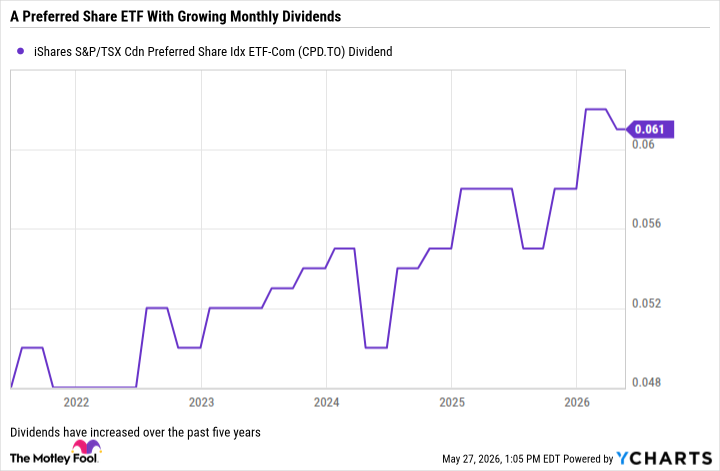
CPD Dividend data by YCharts
But what are preferred shares? They’re hybrid securities that sit between corporate bonds and common stocks in a company’s capital structure. Preferred shareholders get fixed dividends that are typically paid before any dividends go to common shareholders. Preferreds offer higher yields than most government or corporate bonds, making them a valuable income booster and a capital stabilizer during market turbulence.
The CPD ETF has a rock-solid stock selection methodology. It selects preferred shares with a credit rating of at least P-3 (investment grade), listed on the TSX, and denominated in Canadian dollars to eliminate currency risk. No single issuer exceeds 10% of the portfolio, and managers rebalance the portfolio quarterly to contain company-specific risk.
A management expense ratio (MER) of 0.49% implies investors pay $4.90 per every $1,000 invested annually – reasonable for a niche fixed-income-like product.
Top holdings include preferred-share tranches from TC Energy, Fortis, and several Big Six Canadian banks. By weight, insurance companies lead at 30.3%, followed by energy (21%), utilities (17.5%), and banks (11.9%), with telecom and consumer staples rounding out the mix. This sector diversity helps smooth out dividend payments.
Because preferred shares behave somewhat like long-duration bonds, CPD can complement a portfolio heavy on common stocks or GICs, adding a new dimension of monthly income. The CPD ETF has produced a respectable average annual total return of 6.3% over the past 10 years, with dividends doing the heavy lifting.