The Bank of Canada’s monetary policy decisions can significantly impact the stock market. This is because its monetary policy determines how much money will flow into the economy. Think of the Bank of Canada as a dam and the interest rate as a large door controlling the flow of the river. The Bank of Canada lowers the interest rate barrier, allowing money to flow into the economy, and raises the barrier to reduce money flow. Hence, investors should follow what the Bank of Canada is saying.
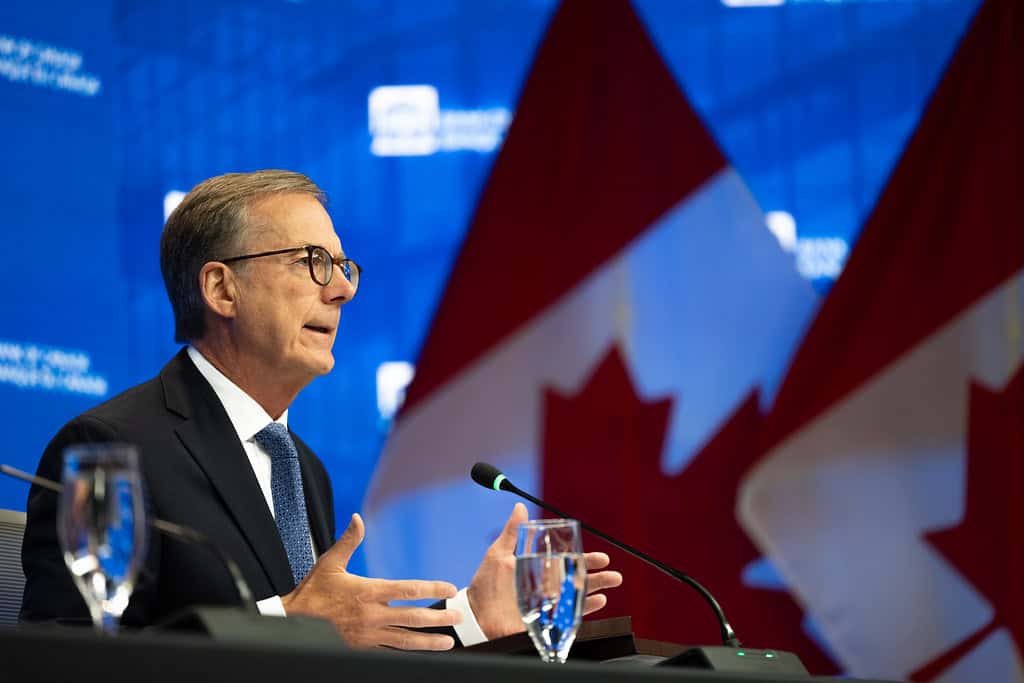
Governor Tiff Macklem; Source: Bank of Canada
The Bank of Canada speaks up again
The Bank of Canada has maintained its interest rate at 2.25% since October 2025, despite concerns of a rate hike. When economic growth is weak, interest rates need to remain low so that money flows into the economy and supports growth.
On the contrary, rising inflation from higher oil prices triggered by the US-Iran war is putting pressure on the central bank to increase interest rates. A higher interest rate will reduce the money supply. When people don’t have money, consumption will slow and prices will fall. However, that will affect economic growth, which is already weak.
Now, the Bank of Canada would hold interest rates steady until inflation data shows signs of widespread and more persistent inflation pressures.
Why so?
Inflation is rising because of the war, and it is not clear if the war will be prolonged. If the US and Iran reach a negotiation and open the Strait of Hormuz, energy prices would fall drastically, and inflation would be contained. This would leave an interest rate hike ineffective, as it takes months for the hike to seep into the economy and make a difference.
It is safe to say that interest rates will remain stable for the next few months, but a rate hike cannot be ruled out. Right now, stocks that will benefit from rate cuts are trading low, as the expectation is of a rate hike.
TFSA stocks to buy if you expect interest rates to increase
A rise in interest rates reduces the money supply and pulls the stock market down. In such a market, bank and grocery stocks outperform as investors move to fixed deposits that offer a higher risk-free return and consume affordable instead of premium products.
Royal Bank of Canada (TSX: RY) stock has already surged 31% from its March dip to a new high on the back of strong performance from wealth management and capital markets. An interest rate hike could bring strong growth in net interest income from personal and commercial banking, which accounts for 65% of its interest income.
A rate hike could see an immediate correction in the wealth management business as many investors would shift from risky stocks to term deposits. It would take time for the rate hike to reflect in loan and deposit numbers, and thus might delay its share price rally.
Supermarket chain Loblaw’s stock surged 6% year-to-date as uncertainty around interest rate decisions kept the stock volatile. You can buy and hold this stock for the long term as it will grow in an uncertain economy.
TFSA stocks to buy if you expect the Bank of Canada to cut the interest rate
A rate cut will only come when economic growth takes a back seat, and fears of a recession emerge. To ease fears and support growth, the Bank of Canada cuts the interest rate and makes borrowing cheap. This increases the gold price, and investors move away from term deposits to dividend stocks for better yields. Growth stocks also do well, as money is easily available, encouraging capital investment.
Lundin Gold (TSX: LUG) will benefit from a low-interest-rate environment as its low production cost increases profits when the gold price rises. Central banks worldwide have been buying gold amidst global tensions, driving the gold price. Its variable dividend policy of distributing surplus free cash flow above $300 million makes it a lucrative dividend yield as well.
The stock has dipped 31% since April, when bank stocks surged. Now is a good time to buy and hold Lundin Gold stock. Its price will jump when discussions around a rate cut begin. Until then, you can enjoy variable dividends.