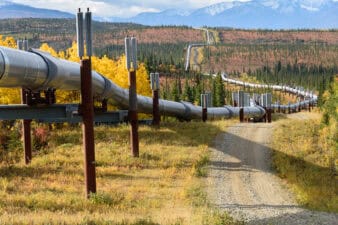
Canadian investors should not overlook energy stocks in 2026. And there’s a $140-billion reason why.
That was the value of Canada’s crude oil exports in 2025, according to the Canada Energy Regulator. Canada exported 4.3 million barrels of crude oil per day (boe/d) that year, with 90.1% of that volume going to the United States.
The story is not slowing down, either. The Canada Energy Regulator said Canadian crude oil and equivalent production averaged a record 5.35 million barrels per day in 2025, up from 5.14 million boe/d in 2024. Production reached 5.64 million boe/d in December 2025.
Statistics Canada points to the same advantage. Crude oil from the Alberta oil sands remained the largest share of Canadian production in 2025, with oil sands output rising 3.9% to 203.1 million cubic metres. It also noted that the expanded Trans Mountain pipeline helped ease an export bottleneck and opened new opportunities to deliver Canadian crude to Asian markets. Canadian Natural Resources (TSX: CNQ) and Enbridge (TSX: ENB) offer strong ways to take advantage of today’s opportunity.

Source: Getty Images
CNQ
CNQ owns a massive asset base across oil sands mining, thermal in situ production, conventional oil, natural gas, and offshore assets. In the first quarter of 2026, CNQ produced about 1.6 million boe/d, up 4% from the prior year. It also generated adjusted funds flow of $4.4 billion. Thus, CNQ is not just sitting on reserves, but turning production into cash.
CNQ also returned about $1.5 billion directly to shareholders in the quarter through dividends and share repurchases. Its annualized dividend rose to $2.50 per share in 2026, marking its 26th consecutive year of dividend increases yielding 4.4% at writing while trading at 11.7 times earnings.
The risk is oil prices. CNQ can generate huge cash flow when commodity prices are strong, but weaker crude prices can pressure earnings, buybacks, and investor confidence. Regulatory uncertainty around major oil sands growth projects is another factor to watch. Still, for investors who want direct exposure to Canada’s production advantage, CNQ looks like one of the clearest TSX choices.
ENB
Enbridge, meanwhile, is not primarily a producer, but an energy infrastructure giant. The company moves oil and natural gas, operates gas utilities, owns storage assets, and invests in renewable power. That makes it less about guessing next month’s oil price and more about collecting cash flow from the movement and delivery of energy. Canada can produce more oil, but production only matters if energy can reach refineries, export terminals, utilities, and end users. Enbridge stock sits in the middle of that system.
Enbridge reaffirmed its 2026 financial guidance for adjusted earnings before interest, taxes, depreciation and amortization (EBITDA) between $20.2 billion and $20.8 billion, as well as distributable cash flow per share between $5.70 and $6.10.
The dividend record is also hard to ignore. Enbridge increased its quarterly dividend by 3% to $0.97 per share for 2026, or $3.88 annualized. That marked its 31st consecutive annual dividend increase, now yielding about 5.1% while trading at about 26 times earnings. What’s more, Enbridge’s business is tied to energy demand across North America, not just one oil-price cycle. That makes it a steadier way to invest in Canada’s energy advantage.
Bottom line
CNQ and Enbridge stock are not interchangeable. Canadian Natural offers more direct upside if production, oil prices, and shareholder returns remain strong. Enbridge stock offers more predictable income from the infrastructure that supports energy flows.
Together, these show why Canada’s energy advantage still matters on the TSX. Investors looking years ahead do not need to choose between growth and income. They can own the producer turning barrels into cash and the infrastructure giant moving that energy to market.