Enbridge (TSX: ENB) is down about 16% from the 2026 high. Investors who missed the big rally in the stock over the past three years are wondering if ENB is finally oversold again and good to buy for a self-directed Tax-Free Savings Account (TFSA) or Registered Retirement Savings Plan (RRSP) portfolio focused on dividends and long-term total returns.

Source: Getty Images
Enbridge share price
Enbridge trades below $67 per share at the time of writing, compared to the 12-month high around $80. The decline is making the dividend appealing for income investors who can now get a 5.8% yield from the stock.
The pullback that occurred in recent weeks is due to both market and company-specific factors.
Rising oil prices have pushed up concerns that inflation will start to spread through the broader economy. This has led to expectations of renewed hikes in interest rates by the U.S. Federal Reserve and the Bank of Canada. Bond markets are already reacting, with yields on government bonds moving higher. This is a headwind for Enbridge and other rate-sensitive companies that use debt to fund growth initiatives, including development projects that often cost billions of dollars and can take years to complete before they begin generating revenue.
Higher borrowing expenses can reduce profits and will cut into cash that can be used to reduce debt or pay dividends. A steep increase in the cost of funds can also force firms to delay planned projects, which slows down growth. Investors saw the impact of rising interest rates in 2022 and 2023 when Enbridge’s share price slid from $59 to $44 before starting its recovery.
On the business side, Enbridge has remained active on the acquisition front. The company has announced two deals in the United States that will bolster Enbridge’s oil pipelines group. Enbridge first agreed to a US$600 million cash deal to acquire infrastructure in the Permian Basin that will connect producers to Enbridge’s oil export facility in Texas. The latest purchase is a US$2.55 billion cash deal to buy oil gathering , transmission, and storage assets in the U.S. Rockies region from Tallgrass Energy.
Enbridge issued new common shares in a $2.6 billion bought deal offering at $66.85 per share to fund part of the Tallgrass transaction. The news led to the recent drop in the share price, which had been above that level before the announcement.
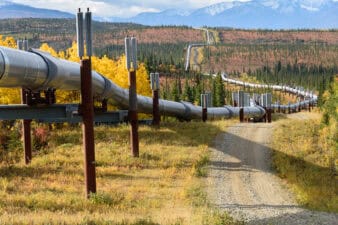
Finally, Enbridge’s Line 5 pipeline, which runs from Wisconsin through Michigan to Ontario, has been a concern for investors. The governor of Michigan wants to shut down the pipeline, arguing it represents a pollution threat. A section of Line 5 runs underwater along the Straits of Mackinac, which is the connection point between Lake Michigan and Lake Huron.
Upside
In addition to the recent acquisitions, Enbridge is working on a $41 billion capital program that will see the company invest $10 billion to $11 billion annually over the next four years. As these projects are completed and go into service, the boost to distributable cash flow is expected to average about 5% per year. That should enable the board to maintain annual dividend increases. Enbridge raised the dividend in each of the past 31 years.
Canada’s push to ship more energy to international buyers could lead to new growth opportunities for Enbridge in the home market. Additional investment in the United States is also likely, as demand for both oil and natural gas rises.
The bottom line
Near-term turbulence should be expected. Any news of rate hikes by the central banks would likely put additional pressure on the stock. That being said, investors who already own ENB should probably sit tight, as they get paid well to ride out the volatility. New investors focused on income might want to start nibbling at this level and look to add to the holding on further downside.