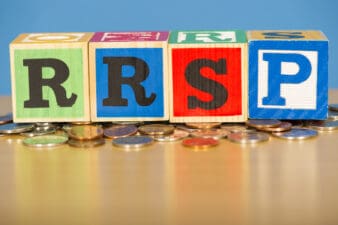
Watching a Registered Retirement Savings Plan (RRSP) cross $1 million should feel like winning retirement. It represents decades of contributions, sacrificed spending, and enough patience to survive several market crashes without moving permanently into a backyard bunker.
However, the entire balance doesn’t belong to the investor in quite the way a Tax-Free Savings Account (TFSA) does.
An RRSP provides a tax deduction on contributions and allows investments to compound without annual taxation. Withdrawals eventually become taxable income. A rapidly growing account can therefore create increasingly large tax bills, mandatory withdrawals, and reduced income-tested benefits.

Source: Getty Images
Not $1 million to spend
Money inside an RRSP is generally taxed when withdrawn. The final amount available for spending depends on the investor’s marginal tax rate at that time.
Someone withdrawing $40,000 doesn’t simply receive $40,000 of permanently tax-free spending money. The financial institution may withhold tax, but that withholding isn’t necessarily the final bill. The withdrawal is added to other taxable income when the annual return is filed.
An RRSP must mature by December 31 of the year its owner turns 71. It can be withdrawn, used to purchase an annuity, or transferred into a Registered Retirement Income Fund (RRIF). A direct RRIF transfer normally avoids immediate tax, but minimum taxable withdrawals begin the following year.
At age 72, the standard minimum factor is 5.4%. A $1.2 million RRIF would require a $64,800 withdrawal before the Canada Pension Plan (CPP), Old Age Security (OAS), a workplace pension, or other income enters the calculation.
Don’t wait until 71
The years immediately after leaving work can provide an opportunity. Someone retiring at 62 may have lower taxable income before CPP, OAS, workplace pensions, and mandatory RRIF withdrawals are all operating together.
Taking planned RRSP withdrawals during those years could reduce the future RRIF balance and spread taxable income across more of retirement. The withdrawn money could fund expenses or, when contribution room is available, be moved gradually into a TFSA.
This doesn’t mean emptying the RRSP early. It means comparing the tax rate paid today with the combined tax and benefit consequences that could arrive later. A tax professional can model that decision using personal income, provincial rates, pension-splitting opportunities, and a spouse’s retirement accounts.
Keep investing
One stock I’d consider for the longer-term portion is Suncor Energy (TSX: SU). The integrated energy company produces oil, operates refineries, and sells fuel through Petro-Canada. Its refining operations can provide some support when conditions weaken for oil production, although they don’t eliminate commodity risk.
Suncor stock matched its quarterly record with $5.3 billion in adjusted funds from operations (AFFO) during the second quarter. Free funds flow reached a record $3.38 per share, allowing the company to return nearly $1.8 billion through dividends and share repurchases.
Management also planned to increase monthly repurchases to $500 million beginning in August. Reducing the share count can increase each remaining investor’s ownership of future earnings and cash flow.
Strong results
Near $95.29, Suncor stock trades around 12.5 times trailing earnings and offers an approximately 2.5% dividend yield. The earnings multiple looks reasonable in isolation, but the stock has rallied well above the $79.58 quantitative fair-value estimate.
I wouldn’t chase it with an entire RRSP contribution. Gradual purchases leave room for weaker oil prices, narrower refining margins, or an operational outage to create a better entry point.
Suncor stock can support long-term RRSP growth, but its commodity exposure makes diversification essential. Taxes are already enough excitement for one retirement account.
Bottom line
A large RRSP is a success, but it’s also a deferred tax obligation. Ignoring that second part can lead to larger mandatory withdrawals, higher tax rates, and reduced benefits later.
Investors can keep compounding through businesses such as Suncor stock while planning withdrawals before age 71 and coordinating the RRSP with a TFSA and other income.
The goal isn’t to prevent the RRSP from becoming large. It’s ensuring the after-tax retirement lifestyle grows along with it.