Diversification is supposed to make the bad days less bad. Stocks fall, bonds behave. Bonds wobble, stocks hopefully pick up the slack. Lately, that relationship has been considerably less predictable.
Global bond yields have surged as investors wrestle with inflation, energy prices and the possibility that interest rates stay higher for longer. On October 1, the TSX slipped to a 10-week low while the global bond selloff pushed borrowing costs sharply higher. U.S. 10-year Treasury yields even touched their highest level since 2002 before retreating.
Friday brought some relief after weaker U.S. jobs data pulled yields lower. Yet stocks and bonds can absolutely fall together. There is, however, one Canadian business that doesn’t necessarily mind when everyone starts frantically moving money around.
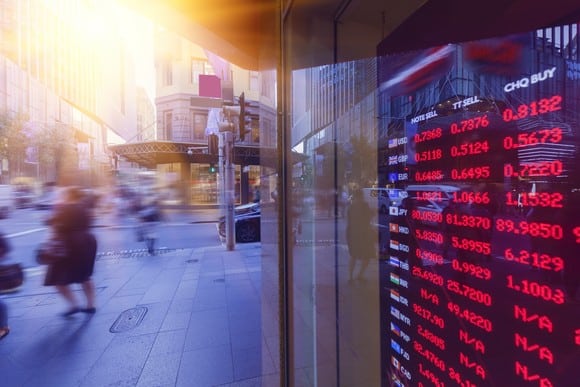
Source: Getty Images
When bonds stop helping
Bonds generally fall when yields rise. A newly issued bond paying a higher rate makes yesterday’s lower-paying bond less attractive, so its market price drops. Stocks can get squeezed at the same time. Higher yields increase borrowing costs and give investors more attractive alternatives to equities. They also reduce the present value investors are willing to pay for profits expected years into the future.
That can produce a portfolio screen where almost everything is red. It’s also why investors shouldn’t abandon diversification during a stock market correction. Bonds still serve an important role depending on an investor’s timeline and risk tolerance. Yet periods when several asset classes swing at once can create another opportunity entirely. Someone still gets paid when investors trade.
Follow the transactions
TMX Group (TSX: X) owns the Toronto Stock Exchange, TSX Venture Exchange and Montréal Exchange, along with clearing, market-data and analytics businesses. Essentially, TMX operates part of the plumbing behind Canadian capital markets. Companies pay to list, and investors trade equities and derivatives through its marketplaces. Financial institutions buy data and analytics, and more market activity can therefore translate into more revenue.
Fear doesn’t guarantee higher profits, but volatility can certainly give investors more reasons to trade, hedge and reposition portfolios. That has already been showing up in the numbers. TMX generated $487.5 million in second-quarter revenue, up 16% year over year. Revenue from derivatives trading and clearing climbed 15%, while stronger volumes helped equities and fixed-income trading and clearing revenue rise as well.
More than a trading story
TMX has also been building businesses that don’t rely entirely on daily trading activity. Its Global Insights division includes market data, indices and analytics. The company completed its acquisition of RAFI Indices in August, further expanding a business that can generate recurring revenue from investors and institutions using its information and index products.
Management ultimately wants more than two-thirds of TMX revenue to be recurring while targeting double-digit long-term adjusted earnings-per-share growth. Shareholders are already seeing some of that cash come back. TMX increased its quarterly dividend another 8% this summer to $0.26 per share, its third dividend increase in 12 months. The yield is only about 2% at a recent share price near $52.55. So this is more growth stock than income machine.
The last decade
Split-adjusted TMX shares traded around $9.72 in October 2016. At roughly $52.55 today, that works out to about 18.4% annualized share-price growth. If that historical pace somehow continued, the numbers become fairly ridiculous:
| RECENT PRICE | HISTORICAL CAGR | 5-YEAR PROJECTED PRICE | 10-YEAR PROJECTED PRICE |
|---|---|---|---|
| $52.55 | 18.4% | $122.19 | $284.11 |
Those projections are illustrations, not forecasts. Nobody should expect an 18% return to simply march forward because Excel asked nicely. TMX also trades around 24 times trailing earnings, so investors are paying for quality. Lower trading activity could hurt transaction revenue, while acquisitions bring integration risk.
Bottom line
That valuation means I wouldn’t chase the stock simply because markets had a rough week. Investors still need to consider price when buying stocks in Canada. Still when stocks and bonds fall together, the obvious response is to search for somewhere untouched by the chaos.
TMX offers a different idea. It owns infrastructure investors keep using because of the chaos. Market fear will eventually fade. The bigger opportunity is that TMX can continue collecting fees from trading, clearing, listings, derivatives and increasingly recurring data businesses regardless of which asset class investors decide to panic about next.