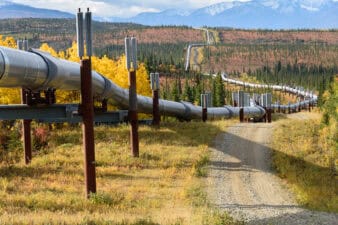
Enbridge (TSX: ENB) has pulled back about 18% from its 52-week high, pushing its dividend yield to roughly 5.9%. While higher interest rates could put further pressure on the stock, the current valuation could offer income-focused investors an attractive opportunity to lock in a substantial stream of dividend income.

Image source: Getty Images
Why Enbridge could deliver attractive income
Interest rates remain an important risk for high-yield stocks. The Bank of Canada’s policy interest rate is currently 2.25%, well below its 5% peak in July 2023. Back then, Enbridge traded around $48 per share and offered a much higher dividend yield of approximately 7.4%.
If interest rates rise substantially again, investors could demand higher yields from dividend stocks, potentially putting downward pressure on Enbridge’s share price. At $65.43 per share at writing, the stock trades at a blended price-to-earnings (P/E) ratio of roughly 22.3. A significant increase in rates and renewed weakness in income-oriented stocks could therefore trigger valuation compression.
However, that risk needs to be weighed against Enbridge’s underlying business strength. The North American energy infrastructure giant has delivered steady results, with distributable cash flow (DCF) increasing 1.8% in the first half of the year. Its payout ratio is approximately 65%, comfortably within its targeted 60%–70% range.
This provides a reasonable foundation for continued dividend growth.
What $10,000 could earn over three years
Enbridge targets approximately 5% annual DCF-per-share growth over the medium term and aims to grow its dividend alongside that growth. Recent dividend increases, however, have been closer to 3%. For a more conservative estimate, assume the dividend grows by 3% annually over the next three years.
At $65.43 per share, a $10,000 investment would purchase approximately 152.8 shares. Under that assumption, the investment could generate roughly $1,874 in cumulative dividends over three years, assuming the dividend increases take place around the usual time in mid-February.
By the end of the three-year period, the annual dividend yield on the original investment — known as yield on cost — could approach 6.5%.
That income is the key reason investors may want to consider Enbridge despite the possibility of additional share-price volatility. Even if the stock temporarily declines, shareholders continue collecting dividends as long as the company maintains its payout.
A compelling income play, but leave room for more
Enbridge is not a risk-free investment. Higher interest rates could weigh on its valuation, and investors should be prepared for periods of share-price weakness. Nevertheless, its predictable cash flows, strong infrastructure assets and attractive dividend make it a potentially solid foundation for a diversified portfolio.
At $65.43, the analyst consensus price target implies roughly 21% near-term upside. For income-focused investors, starting with a partial position could make sense, while keeping cash available to buy more if higher rates trigger further correction.
The bottom line
A $10,000 investment in Enbridge today could generate approximately $1,874 in dividends over the next three years under a conservative 3% annual dividend-growth assumption. For investors prioritizing reliable income, that potential cash flow makes Enbridge worth considering — even if interest-rate risks create opportunities to buy the stock at lower prices.