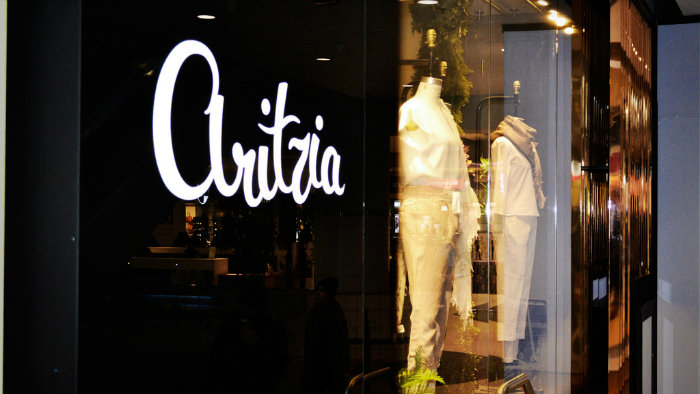
Things are happening fast for Aritzia Inc. as it prepares to go public later this month. Three weeks ago it filed its preliminary prospectus with Canadian securities regulators, and yesterday it provided some more details for investors as to what they can expect from its IPO–the biggest retail coming-out party since Dollarama Inc. (TSX:DOL) went public in 2009.
Selling 20 million subordinate voting shares to be priced between $14 and $16, Aritzia will trade on the TSX under the symbol “ATZ.” Assuming the over-allotment option of three million shares is exercised by underwriters within 30 days of the company’s IPO, Berkshire Partners, Brian Hill (CEO), and family will receive $327.8 million in net proceeds after underwriting fees are taken into account.
After the IPO, Aritzia will have 26 million subordinate voting shares outstanding along with 10.1 million options to buy shares and 83.9 million multiple voting shares. Assuming the exercise of the 10.1 million shares, Aritzia’s total number of outstanding shares would be 117.1 million for an IPO market cap of $1.8 billion and an enterprise value of $1.9 billion.
That’s a multiple of 20 times adjusted EBITDA–exactly the same as Lululemon Athletica Inc. (NASDAQ:LULU).
But enough about the highlights. You want to know about the demons lurking behind Aritzia’s doors. While I’m not sure there’s anything too ghastly going on at Canada’s hottest retailer, I do think you should be aware of these five points before buying shares of its IPO.
As they say, buyer beware.
1. Aritzia currently generates approximately $1,465 in sales per square foot–one of the highest in the industry.
In its marketing materials for its IPO, it positions itself between “affordable luxury” and “fast fashion” in the global fashion landscape, stressing “beautiful high-quality products at an attainable price point.” Investors should be under no illusion that this level of customer engagement can be maintained indefinitely. The future expansion of its store network faces significant difficulties in maintaining these numbers.
Former Lululemon CFO John Currie, a director of Aritzia, is only too well aware of what can happen when momentum slows.
2. Its e-commerce business currently represents approximately 12% of revenue.
Its goal is to get to 25% by 2021. That’s an admirable goal, but if you’ve been reading any retail news lately, you’ll know that the investment in dollars and manpower required to run an online business isn’t cheap, and the profit margins, once thought to be higher than brick-and-mortar locations, are actually worse. It’s important that you have an omnichannel retail business, but it comes at a cost.
3. Consider Aritzia’s Legacy Option Plan, an incentive program in place for executives, directors, past execs, and all other eligible employees.
A total of 87 people stand to make $159 million in pre-tax profits, perhaps more (assuming an opening-day spike), diluting your investment by approximately 10%, and that’s not including the dilution from the 23 million subordinate voting shares sold in the offering. But worst of all, it’s made no reference to the front-line store employees and how they’ll benefit from the IPO. Socially responsible investors might want to consider this.
4. Brian Hill and family intend to maintain a long-term equity ownership level between 20-25%.
While Hill is CEO, that seems like a logical decision. After the IPO, Hill and family will have 33.3% of the equity and 41.3% of the votes. Selling off between 8% and 13% over the next couple of years provides diversification for the CEO while maintaining significant skin in the game.
How is that a bad thing? It’s not. However, once Berkshire Partners moves on, it’s impossible to know if the same scenario plays out that played out with Chip Wilson and Lululemon. And we know how that turned out.
5. Berkshire Partners, the Boston-based private equity firm that bought the majority ownership in Aritzia in 2005, will own 56.1% of the voting shares upon completion of the IPO.
Like most IPOs, its lock-up is 180 days, which means it can’t sell those shares until sometime in March. Normally, private equity interests are eager to dispose of their long-term investments, so they can close out the funds whose capital was used to make the original investment. It’s been 11 years, so expect some action come spring.