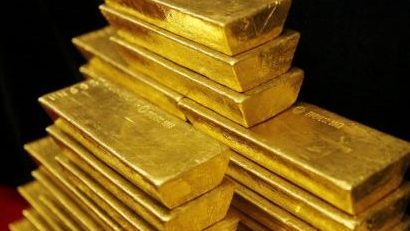
Gold has taken a hammering in recent says to see it tumble below the psychologically important US$1,200-per-ounce barrier and be trading at US$1,187 an ounce. This sees the yellow metal down by roughly 7% over the last year, and there are signs that it may weaken further in coming months.
This isn’t good news for gold miners, causing the VanEck Vectors Gold Miners ETF to plummet by 22% over that period. The increasingly poor outlook for gold doesn’t bode well for those gold miners with high operating expenses, such as IAMGOLD (TSX: IMG)(NYSE: IAG), which reported second-quarter all-in sustaining costs (AISCs) of US$1,077 per ounce produced.
Now what?
A key driver of the negative environment for gold is the ongoing U.S. economic upswing, and its gross domestic product (GDP) is growing at a solid clip. It is estimated that second-quarter 2018 GDP expanded by a remarkable 4.1%, or a notable 1.5% greater than the equivalent quarter in 2017. That solid growth is expected to continue because of Trump’s fiscal stimulus and growing business confidence.
As a result, the Fed has moved swiftly to normalize interest rates, bringing an end to the abundant cheap credit that many businesses, especially in capital-intensive industries like mining, have become accustomed to. In late September 2018, the Fed raised rates to a target of 2.25%, which was the third rate hike for the year, indicating that the U.S. economy continues to grow at a solid clip.
Higher rates are bad for gold, because they increase the opportunity cost associated with holding non-income-yielding assets like the yellow metal, while making bonds and other fixed-income investments more attractive. This causes capital to flow out of gold and into fixed-income investments.
Furthermore, as rates rise, the U.S. dollar grows stronger, which is also bad for gold.
You see, commodities such as gold are priced in U.S. dollars because of its stability and status as the world’s major reserve currency. That means as the dollar firms, it becomes costlier for holders of other currencies to buy gold, which, in turn, causes demand for the precious metal to wane.
Clearly, if the U.S. economy continues to strengthen at a significant clip, then rates will rise further, and the dollar will firm, placing even greater pressure on gold. It is possible that gold could fall to as low as US$1,100 an ounce in coming months if many of the geopolitical risks that emerged since Trump became president diminish and the U.S. economic boom gains further momentum.
That price is not much above the estimated marginal cost of production, which analysts from a range of banks and commodity trading enterprises believe to be at around US$1,080 per ounce. This emphasizes why US$1,200 per ounce is such an important price, because it is at this point where the majority of gold miners become profitable. They have also used it as the forecast price to calculate reserves, meaning that any protracted slump which sees gold fall to around US$1,100 an ounce or lower for a sustained period would cause many gold miners reserves to decline. That would have a sustained impact on their market value.
So what?
Among the hardest hit would be high-cost operators like IAMGOLD, because its AISCs are only around 9% lower than gold’s current spot price. This means that as gold weakens, the company will be forced to savagely slash costs, which will cause it to dial down its exploration and mine development activities. That could very well impact on its ability to expand gold production and bolster its reserves.
Nonetheless, by the end of 2017, IAMGOLD had increased its gold reserves by 86% year over year to 14.5 million ounces and has a strategy in place aimed at reducing AISCs to US$850 per ounce. It also finished the second quarter with greater than US$1 billion in liquidity, which includes US$776 million in cash, leaving IAMGOLD well positioned to weather another downturn in gold.