Canada’s top exporter Enbridge (TSX: ENB)(NYSE: ENB) is taking collateral damage in the recent oil price war. While Saudi Arabia and Russia have put an end to their standoff, oil prices have dropped below zero. Suddenly, investors are worried about the future of the energy sector’s powerhouse.
Can this $85 billion energy infrastructure company still generate sustainable, long-term cash flows? Will the dividends be stable and sustainable moving forward? Perhaps the concerns are real if the projections of a large decline in Canada’s supply over the next three years due to lower oil prices hold.
Attractive features
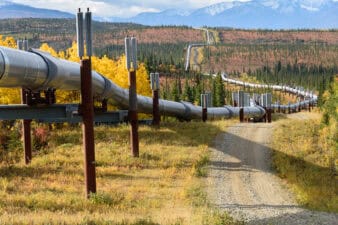
Enbridge isn’t an oil producer; it facilitates the flow of crude and natural gas in its pipelines, including the Canadian Mainline crude pipeline system. Since the company’s pipeline network can accommodate 70% of Canada’s capacity and allows refinery access to various markets, investors are enamoured by the stock.
The company’s regional oil sands pipelines add to the stock’s charm. The regional pipelines that Enbridge operates link directly to its Mainline. Three pipeline expansion projects are also underway and should be fully operational the year-end 2023.
Most of Enbridge’s assets are top notch, if not the best in North America. The diversification it has undertaken fortifies its financial position. At present, its midstream portfolio operates regulated natural gas utilities and gas distribution that serves residential, commercial, and industrial customers (Ontario and New York).
There will be constant cash flow, because pipeline contracts are mostly long term. End users of Enbridge’s pipelines pay capacity reservation fees to cover rent regardless of the market environment. The company charges transportation fees commensurate to the volume of the shipment.
Drawback
The drawback for Enbridge is its history of oil spills that are risks to public safety. Based on U.S. Pipeline and Hazardous Material Safety Administration data, the U.S. portion of Enbridge’s pipeline network suffered a total of 307 hazardous liquids incidents from 2002 to August 2018.
On May 1, 2020, its Herschel pump station at Saskatchewan leaked. The approximately 150 cubic metres of crude oil spilled was promptly reported by Enbridge to the Canada Energy Regulator (CER). A CER inspector is on site monitoring and assessing Enbridge’s clean of the pump station, which is part of the Line 3 pipeline.
Since 2010, Enbridge has paid a total of $248 million in fines due to the environmental, workplace, and other safety violations. In 2017, there was a pair of employee deaths due to an oil spill.
The pressing concern
The bottoming of oil prices is the pressing concern for Enbridge at the moment. This energy stock has lost by 17.5% year to date, but it offers a lucrative 7.42% dividend. The company is due to report its Q1 2020 on May 7, 2020. Analysts are forecasting a 16.4% and 11.9% drop in earnings and revenue, respectively.
One bright spot is the start of the production cuts agreed upon. The easing of lockdown restrictions should also boost the market. However, there is trouble if the slashed output is unable to lift oil prices. Enbridge could sink along with it.