In June, Prime Minister Justin Trudeau extended the Canada Emergency Response Benefit (CERB) from $8,000 to $12,000. This extension came when Canadians least expected it. Discussions are ongoing in the House of Commons on the next step, as the economy enters the next phase of re-opening in September. Will Trudeau extend the CERB to $16,000 or will he end this benefit abruptly?
The Canada Revenue Agency (CRA) extended the CERB in June because the reopening of the economy, after the three-month lockdown, was uneven. Until June, certain areas of southwestern Ontario, including Toronto, were still under lockdown. Probably by September, the economy restart will be more balanced, thereby reducing the need for emergency payments.
Can the CRA end the CERB in September?
But history has proven that it is not so easy to withdraw a popular social spending program immediately. One major reason why Trudeau’s Liberal government was elected in 2015 was on the promise of introducing Universal Basic Income (UBI).
The CERB has become a lifeline for many Canadians. Can the CERB take the form of a nationwide UBI? It looks difficult, as UBI will put a huge burden on the government. And with Canada’s estimated 2020/2021 fiscal deficit soaring more than 1,000% to $343 billion, UBI appears to be a far-fledged dream.
While Trudeau may not make the CERB permanent, he might extend the benefit to $16,000. There is a possibility that the CRA could stretch the additional $4,000 benefit for a longer period.
Conservatives’ Back-to-Work Bonus proposal
The problem with the current $2,000 CERB payment is that Canadians lose their complete benefit amount if they earn more than $1,000. This is a disincentive for them.
For instance, Jack earns $800 a month as a freelancer. This makes him eligible for the $2,000 CERB payment, increasing his total monthly income to $2,800. If his employer calls him back at an income of $1,500, he will lose his CERB, and his monthly income will almost halve to $1,500.
The Conservatives have proposed a “Back-to-Work Bonus.” Under this plan, the CERB amount will reduce by $0.50 for every dollar earned above $1,000. In Jack’s case, when he starts earning $1,500, he will not lose his CERB completely. Instead, his benefit amount will reduce by $250 ($0.50*500) to $1,750. In this case, his total monthly income will be $3,250.
As Canadians will earn more when they are working than when they are staying at home, they would be encouraged to return to work. The CERB will stop when the individual starts earning $5,000 a month in working income.
An alternative to CERB and UBI
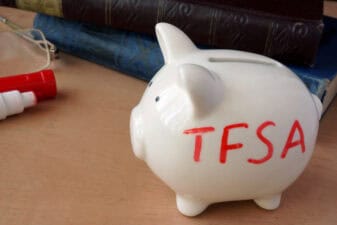
It’s not in your hands to extend the CERB or put in place a UBI platform. However, you have an alternative to make a personal CERB or UBI income that takes care of your basic expenses. Your Tax-Free Savings Account (TFSA) allows your investment income to grow tax-free.
Every year, you can invest $5,000-$6,000 in a growth stock like Kinaxis (TSX:KXS). The stock grew at an average annual rate of around 25-30% in the last five years. If the stock can grow at an average annual rate of 20% in the next 10 years, your contribution of $50,000 will convert into $150,000.
If you invest this $150,000 amount in a dividend stock, with an average yield of 6%, it can fetch you $9,000 a year, or $750 a month. While you earn $750, your lump sum amount will grow along with the market.
There are many dividend stocks that increase their dividend annually. Enbridge increased its dividend per share at an average annual rate of 8% in the last five years. This rate is higher than Canada’s inflation rate of 2.27%.
Investors’ takeaway
Instead of depending on the government and getting stressed over the end of the program, take control of your finances. A personal CERB or UBI can lead you to a stress-free future even in an economic crisis.