Whenever you think of investing in the stock market, two things come to your mind. Is my money safe? Can my stock outperform the market? History has shown that equity gives far better returns than fixed income in the long term. But then most retail investors lose in the stock market. This is because they do intraday trading or active trading. Even if you hire managers to mimic the market index, you might not get the same returns as you have to pay an asset management charge.
How can you outperform the market while minimizing your risk of downside? For that, you need to understand the composition of the stock market index and market dynamics.
How to outperform the market?
The TSX Composite Index has surged 8.58% year to date and 35.7% since April 2020. The 35% surge is the recovery rally that you only see after a market crash. It is like a catapult effect. In a catapult, you need to pull the stone back to accelerate its momentum. Similarly, when the market sees a pullback or a crash, it surges at a faster rate. Hence, analysts always recommend buying the dip of a good share.
Now comes the composition of the index. The index tracks the largest 250 shares of the 1,600 shares trading on the TSX. These 250 shares (large, mid, and small-cap) account for 70% of the TSX market cap. The large-cap stocks give lesser returns, but they also have a lower risk. Whereas small and mid-cap stocks give higher returns as they become large-cap over time.
Shopify is the best example of a mid-cap stock that became a large-cap stock in the last five years, rising over 3,300%. Today, it is the highest valued share on the TSX. It significantly outperformed the TSX Composite Index that surged 36%. And if you buy such stocks when they have become large-cap, you can only mimic the market not beat it.
Finding the next Shopify is not easy. Most small and mid-cap companies cease to exist, and only a few make it to the large-cap. Even stalwarts like Warren Buffett missed out on investing in opportunities like Google. Then how to beat the market?
Create a well-diversified portfolio of large and mid-cap stocks that are trading at a cheaper price. Here I bring to you two growth and dividend shares that can help you outperform the market.
Enbridge stock
Enbridge (TSX:ENB)(NYSE:ENB) is a large-cap dividend stock with a rich history of paying incremental dividends. The stock is currently trading at an attractive valuation of 15x forward price-to-earnings ratio because the pandemic reduced oil demand that pulled its stock price down 35%. The stock partially recovered last year, but it is still trading at a 15% discount from its pre-pandemic level.
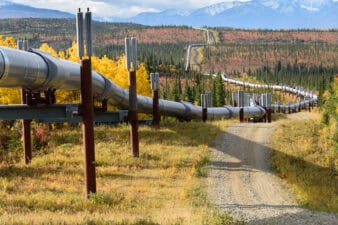
Being a large-cap stock with a widespread establishment of pipeline infrastructure across North America, it has better resistance to the crisis. The stock is a buy the dip, as it will help you lock in a 7% return every year in dividends. As the economy recovers, the share will surge 15% to its pre-pandemic level.
Enbridge is not the stock that will outperform the market, but it is the one that will reduce your downside. Whenever you invest, first secure your portfolio against the downside and only then take the risk with mid-cap stocks that have the potential to outperform.
Lightspeed POS stock
Lightspeed POS (TSX:LSPD)(NYSE:LSPD) is a mid-cap growth stock that has surged 340% in 25 months. It has the potential to be the next Shopify. Lightspeed is growing its revenue through global acquisitions. It aims to become the Android of omnichannel solutions for small and mid-sized (SMB) retailers and restaurants.
The pandemic made Lightspeed platform the need-to-have technology as social distancing became the new normal. Its platform helped retailers offer curbside pickup, inventory and order management, appointment booking, and online payment services. This means retailers can be in the business without opening their shop. However, Lightspeed has sky-high valuations, making it a risky investment.
Investor takeaway
Investing in the underdog may or may not pay off. Hence, when you invest to outperform secure minimum returns first.