Let’s be honest: who hasn’t found themselves daydreaming about quitting their day job and living solely off dividend income? Chances are, the fantasy has crossed your mind – probably during a tedious Monday morning meeting or while staring at an overflowing email inbox.
While it’s an enticing thought, translating this dream into reality requires some serious financial acumen and planning. Unfortunately, a comprehensive breakdown of how to achieve this goal is beyond the scope of this article and probably best suited for an in-depth consultation with a financial planner.
However, what I can offer is a rough sketch – think of it as back-of-the-napkin math – based on some basic assumptions to give you an idea of what it would take to turn this fantasy into your Monday morning reality.
Setting the assumptions
Let’s get real for a moment: living in a big Canadian city like Vancouver is not cheap. According to data from Numbeo, the average monthly cost of living in the city – excluding rent – is $1,471.80.
Add to that a conservative $1,500 for a modest one-bedroom apartment, and we’re looking at a monthly expense of nearly $3,000 just to keep the lights on and put food on the table. For simplicity, let’s round that number up to an even $3,000.
To keep things straightforward, we’ll assume that all your dividend income will come from a Tax-Free Savings Account (TFSA). This eliminates the need to navigate the convoluted maze of tax brackets and rates, which is beyond the scope of this back-of-the-napkin calculation.
To just cover your basic living expenses, you’d need a yearly income of about $36,000 – derived solely from dividends. At a 4% yield, which is about average for Canadian dividend stocks, you’d require a capital investment of a whopping $900,000.
And keep in mind, this is a best-case scenario: it assumes the value of your investments remains stable and you don’t sell any shares to supplement your income. Moreover, this calculation leaves you with virtually no wiggle room; we’re talking about just covering rent and essential living costs – no luxuries or unexpected expenses factored in.
What’s the solution?
Living off dividends may sound like a lofty goal, especially when faced with the realities of high-cost living. However, it becomes a more tangible possibility when you start to examine the power of consistent contributions and compounding interest over time. Let’s delve into the numbers to make this more concrete.
As of now, the annual TFSA contribution limit is $6,500. If you were to contribute this amount consistently each year, over a long period, reaching a portfolio value of $900,000 is entirely possible.
Historically, from 1993 to the present day, an initial $6,500 investment in an S&P 500 index ETF like the BMO S&P 500 Index ETF (TSX:ZSP), along with subsequent annual contributions of $6,500, would have grown to approximately $1,458,650. At a 4% dividend yield, this works out to $58,346 per year, or $4,862 per month.
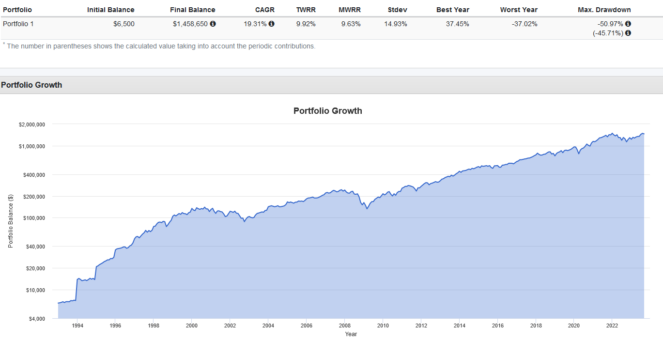
The math might seem overwhelming, but the core lesson is simple: if you want to retire early or achieve financial freedom, you must maximize both the frequency and size of your investment contributions. The sooner you start and the more you can contribute, the faster your investments will grow, thanks to the magic of compound interest.
It’s crucial to note that this is a hypothetical scenario. It’s subject to various real-world factors like changes in TFSA contribution limits, the investments you choose, and inflation, among other variables. But it serves as a compelling example of what’s theoretically possible with disciplined, consistent investing.