More than halfway through 2024, we find ourselves amidst a robust bull market that seems to push the S&P 500 Index to new record highs almost weekly.
If you’re sitting on cash that’s currently earning a steady 5% yield thanks to high interest rates, you might feel tempted to hold off on investing, waiting for a market dip to snatch up shares at a lower price.
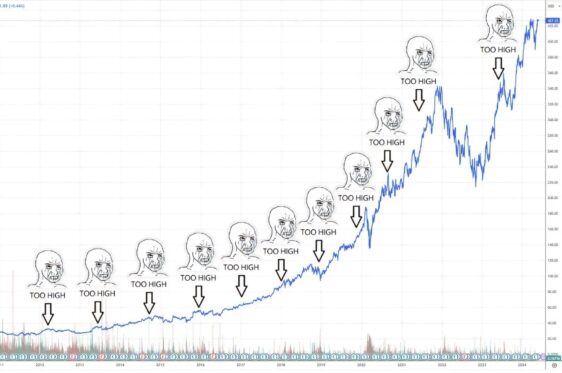
However, this strategy of waiting for the “perfect moment” to invest is essentially market timing, a practice that’s widely criticized for its inefficacy.
Here’s why you should consider investing now, even with the S&P 500 at record highs, and why it could still be a sound decision in the long term.
Don’t miss the bull market!
I totally understand the hesitation you might feel about investing a lump sum right now, especially with the fear that the market could soon correct, leaving your portfolio in the red with unrealized losses.
But historically, bull markets not only last longer but are more frequent and offer more significant gains compared to the losses incurred during bear markets. Let’s consider some research from CFRA:
- The average bull market lasts about 14 months, with the longest stretching from 1946 to 1949 for three years and the shortest lasting only three months in 1987 and 1990.
- Conversely, bear markets tend to be much longer, averaging around 60 months. That’s five years of potentially missing out on substantial gains if you remain on the sidelines!
Moreover, the gains and losses are not symmetrical. The average bull market sees a rise of 165%, whereas the average decline during bear markets is about 35%. The real risk here isn’t necessarily incurring short-term losses but missing out on years of robust compounding growth.
How to invest at all-time highs
If you’re feeling wary about investing during a period of all-time highs, a pragmatic approach would be to implement a strategy known as dollar cost averaging.
For instance, if you have $20,000 ready to invest, consider using it to purchase shares of a diversified, low-cost exchange-traded fund (ETF), such as BMO S&P 500 Index ETF (TSX:ZSP). This particular ETF boasts a low management expense ratio (MER) of just 0.09%.
Rather than investing the entire sum at once, you could distribute this investment over a period to reduce the potential impact of volatility.
A practical way to do this might be to invest $2,000 each week for the next 10 weeks. This strategy allows you to spread out the investment and potentially lower the average cost per share over time.