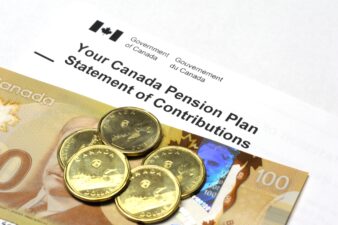
The Canada Pension Plan (CPP) rule is simple: what you contribute is what you get. To earn maximum CPP payout for the long term, you have to invest maximum to the CPP for the long term.
In an ideal scenario, John starts earning at age 20 and retires at age 65, which is 45 years of working. Now, there could be years when he may not be at the peak of his income, maybe due to illness, a career break, unemployment, or other personal reasons. Hence, the Canada Revenue Agency (CRA) takes John’s best 35 earning years to determine his CPP payout at age 65.

Source: Getty Images
How does the CRA calculate the maximum CPP payout?
For 2025, the maximum CPP payout is $1,433 per month, or $17,196 a year. The CRA keeps updating this amount to adjust for inflation. This amount will increase as the CRA implements the two-phase CPP enhancement program in 2019.
- Phase one: The CPP contribution rate for employees increased from 4.95% to 5.95% between 2019 and 2023.
- Phase two: An additional 4% CPP contribution was added for people earning more than the maximum pensionable earning and up to a certain limit.
| Year | Maximum annual pensionable earnings | Employee and employer contribution rate | Maximum annual Employee and employer contribution | Maximum annual self-employed contribution |
| 2025 | $71,300 | 5.95% | $4,034.10 | $8,068.20 |
| 2024 | $68,500 | 5.95% | $3,867.50 | $7,735.00 |
| 2023 | $66,600 | 5.95% | $3,754.45 | $7,508.90 |
| 2022 | $64,900 | 5.7% | $3,499.80 | $6,999.60 |
The CRA updates the maximum annual pensionable earnings annually. The first $3,500 is exempt from CPP contributions. Any income above that is used to calculate CPP contributions. If your salary matches or exceeds the maximum annual pensionable earnings for 35 years, you have a high probability of getting the maximum CPP when you retire.
How much salary do you need to get the maximum CPP payout?
| Year | Additional maximum annual pensionable earnings | Employee and employer contribution rate | Maximum annual employee and employer contribution | Maximum annual Self-employed contribution |
| 2025 | $81,200 | 4% | $396 | $792 |
| 2024 | $73,200 | 4% | $188 | $376 |
If your annual salary is $81,200 ($6,767 per month) for 2025, you will make the maximum CPP contribution of $4,430.1 and come closer to the maximum CPP payout.
You can look at CRA’s table and tick the years where you made maximum contributions. While you cannot change the past, you can change the future and strive to earn the maximum pensionable earnings and achieve the golden 35 years.
Despite these efforts, the CPP can only supplement 35% of your retirement needs. If you earn maximum CPP payout, the CRA will claw back other benefits like the Old Age Security (OAS) pension and the Guaranteed Income Supplement (GIS).
Diversify your retirement passive income
The OAS and GIS clawback depends on your taxable income after age 65. The Registered Retirement Savings Plan (RRSP) withdrawals are taxable, and so are other passive-income sources such as rent, royalty, commission, and even CPP payout.
However, the Tax-Free Savings Plan (TFSA) withdrawals are tax-free and not added to the retirement income when calculating OAS and GIS. You could diversify by creating a TFSA passive income with dividend stocks.
Just as you contribute $3,000-$4,000 in CPP, you could consider investing a similar amount in TFSA. In the initial years, when you have more than 15 years to retire, consider investing in growth stocks like Descartes Systems, which could double your investments in five years. Once that amount builds your TFSA portfolio value, you could consider allocating 15% or 20% to dividend stocks like Enbridge (TSX:ENB).
The Trump tariffs could affect Enbridge’s earnings in the short term. However, the company’s low-risk business model has sufficient buffer to handle such macroeconomic events. This may not affect its ability to pay quarterly dividends and grow them. Enbridge’s stock is currently trading at a cyclical high. It is better to wait for the stock to fall to $50 to lock in a dividend yield of over 7%.