Typically, a company’s share price and dividend yield have an inverse relationship. So, investing in beaten-down dividend stocks might help you benefit from a high yield as well as capital gains when market sentiment recovers.
Freehold Royalties (TSX:TSX) is one of the top TSX dividend stocks, which is down 53% from its all-time high. However, this drawdown has increased the dividend yield to more than 8%, making it attractive to income-focused investors.
Valued at a market cap of $2.2 billion, generates revenue from oil and gas royalties on its land. The company targets a 60% dividend payout ratio and requires a $50/barrel West Texas Intermediate (WTI) price to cover costs and dividends, while implementing share buybacks for additional capital returns.
Let’s see if you should own this TSX stock right now.

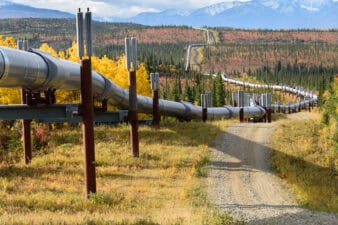
Image source: Getty Images
How did the TSX stock perform in Q2?
Freehold Royalties delivered solid results in the second quarter (Q2) of 2205, as production levels of 16,584 barrels of oil equivalent (BOE) per day grew by 9% year over year. This production growth showcases the resilience of Freehold’s diversified North American portfolio despite volatile commodity markets and economic uncertainty.
During the quarter, 31 high-productivity wells across six drilling pads in the Permian and Eagle Ford basins came online with initial production rates exceeding 73,000 BOE per day. These wells outperformed historical offset wells, with Freehold capturing a 1.1% average net royalty interest, more than double its typical U.S. rate.
The combination of superior well performance and higher royalty percentages created substantial value for shareholders. Freehold’s exposure to premier operators ConocoPhillips and ExxonMobil, which account for 60% of U.S. revenue, provides stability.
In Q2, Freehold’s funds from operations stood at $57 million, even though oil prices averaged US$64 per barrel, down 11% compared to the previous quarter. Notably, at similar oil prices four years ago, Freehold’s funds from operations per share were 40% lower, which highlights the portfolio improvements resulting from strategic U.S. acquisitions that deliver premium-priced light oil.
The TSX stock returned $44 million to shareholders through dividends while investing $12 million in undeveloped mineral title lands in core Permian areas, expecting returns of 10% to 20%.
With net debt at 1.1 times trailing funds from operations and a sustainable dividend payout ratio, Freehold demonstrates strong capital discipline. However, headwinds include weaker gas pricing, which may impact Canadian Cardium activity, and ongoing commodity price volatility that could pressure future cash flows if sustained.
Is the TSX dividend stock undervalued?
Given consensus estimates, Freehold is forecast to end 2028 with a free cash flow of $285 million, compared to a free cash outflow of $184 million in 2024. A widening cash flow base should enable Freehold Royalties to target accretive acquisitions and strengthen the balance sheet.
Despite the expected increase in free cash flow, the TSX stock is expected to maintain its annual dividend per share of $1.08 through 2029.
Moreover, analysts tracking the TSX stock forecast it to gain 20% over the next 12 months, given price target estimates. If we adjust for its dividend yield, cumulative returns could be closer to 28%.