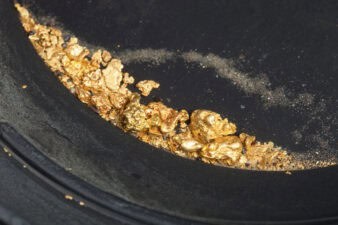
The price of gold hasn’t shimmered this bright in years, yet volatility in the markets and economy has led investors to flee towards the precious metal. At writing, the price of gold has surged past record highs, recently touching US$4,000 per ounce!
There are many reasons for this, including global uncertainty and expectations of future rate cuts in the United States. Furthermore, traditional drivers are still at play. These include hedging against inflation, low real interest rates making non-yielding assets more appealing, a weaker U.S. dollar, and an increased demand in safe haven investments.
So, what do Canadian investors need to know when investing in gold? Let’s take a look.

Source: Getty Images
Key points
There are a few points that Canadians need to know before investing in gold. In particular, gold is priced globally in USD. For Canadians, the CAD/USD exchange rate therefore magnifies or mutes returns. Therefore, even if gold in USD goes up, a stronger loonie could blunt gains.
Furthermore, physical gold and bullion don’t yield income through dividends or interest. It’s solely a capital-return and store-of-value play. Gains on gold are also taxable, so treated as capital gains. Then there are the rate cuts and how these affect gold. If central banks delay cuts or tighten again, or inflation surprises come down, gold could pull back.
A shift in interest rates can therefore be one of gold’s biggest enemies. That’s why it can be a far better option to use gold as a hedge and diversification asset rather than a core engine for gains. A typical allocation could be around 2% to up to 10% of your portfolio value. In the meantime, there are other ways to get in on gold’s growth.
Consider ETFs or stocks
As gold rises, many investors rotate towards mining stocks and royalty or streaming names because of the leverage effect. Mining profits often grow faster than the gold price, and that can provide far more real returns in the meantime. Furthermore, high gold prices encourage more exploration, re-opening of marginal mines, and additional production.
One option investors might want to consider is the iShares S&P/TSX Global Gold Index ETF (TSX:XGD). This ETF tracks the global gold index, offering a one-year return of 51% at writing! The ETF provides broad exposure across miners on a global scale, diversifying company-specific risk. However, it’s levered to mining companies not physical gold. Therefore, if costs or risks increase, miners can underperform. So that’s something to watch.
A stock to watch in this case could be New Gold (TSX:NGD), a mid-tier producer often responsive to gold price movements. During the second quarter, the company reported strong results, with solid net income growth. Here, investors will need to watch higher execution risks, inflation costs, and operational leverage as these can work both ways. Yet with shares now trading near 52-week highs, and a huge turnaround from a few years back, investing is a strong way to play higher gold prices.
Bottom line
All considered, surging gold prices come with their own benefits and risks. But no matter how you slice it, buying a bunch of bullion probably isn’t your best option. Instead, investing in companies that invest in gold can be a smarter play. That’s why XGD and NGD both look like solid options on the TSX today.