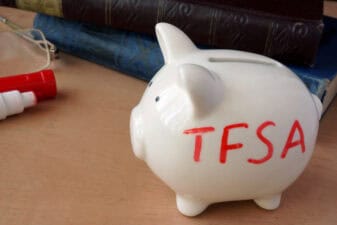
A Tax-Free Savings Account (TFSA) can feel a little magical when the cash starts arriving tax-free. Not fairy-tale magical. No woodland creatures will file your taxes. Still, dividend income that can grow and compound without adding to taxable income is about as close as personal finance gets to a tidy little trick.
Source: Getty Images
Getting started
The Canada Revenue Agency (CRA) says TFSA contributions and income earned inside the account, including dividends and capital gains, are generally tax-free even when withdrawn. That’s why the account works so well for investors who want income today, income later, or a retirement cushion that does not come with a tax-season ambush.
The one catch is contribution room. The CRA says the 2026 TFSA dollar limit is $7,000, added on January 1, 2026. So a $10,000 TFSA investment only works if an investor already has enough unused contribution room carried forward. Otherwise, the CRA may show up with penalties, and nobody wants their passive income interrupted by tax math in a bad mood.
So what can $10,000 actually do? It won’t replace a paycheque, but it can start a cash machine. Reinvest the dividends, add new contributions, and let time do the heavy lifting. Very rude of time to be slow, but it does work. Investors looking for a dependable Canadian dividend stock to start with should consider Bank of Montreal (TSX: BMO).
BMO
BMO stock is one of Canada’s Big Six banks, with operations in personal and commercial banking, wealth management, capital markets, and U.S. banking. That gives it several ways to earn money as households borrow, businesses expand, clients invest, and markets recover.
The dividend case looks solid. BMO declared a quarterly dividend of $1.71 per common share for the third quarter of fiscal 2026, up four cents from the prior quarter and higher than the year before. That brings the dividend yield to about 2.8%. At about $10,000 invested, that could bring in strong income each year.
| COMPANY | RECENT PRICE | NUMBER OF SHARES | ANNUAL DIVIDEND | ANNUAL TOTAL PAYOUT | FREQUENCY | TOTAL INVESTMENT |
|---|---|---|---|---|---|---|
| BMO | $251.15 | 39 | $6.84 | $266.76 | Quarterly | $9,794.85 |
That figure may not sound huge. It is not supposed to be huge yet. The first goal is to build the machine. A $10,000 investment can buy the first parts. Future contributions and reinvested dividends can keep adding gears.
Numbers don’t lie
The latest earnings support the income story. In the second quarter of 2026, BMO stock reported adjusted earnings per share (EPS) of $3.67, up from $2.62 a year earlier. Adjusted return on equity improved to 13.5%, while provisions for credit losses fell to $739 million from $1.1 billion.
That is the number combination investors should like. Higher earnings, better profitability, and lower credit provisions give BMO more room to support dividends and invest in growth. Banks do not need to be thrilling. They need to keep earning money without setting off alarms. The valuation also looks reasonable for a blue-chip bank. BMO stock trades at about 19.3 times earnings at writing. So not bargain-bin cheap, but investors are paying for a large Canadian bank with dividend growth, improving credit trends, and a long operating history.
The risk is the economy. If unemployment rises, borrowers fall behind, or commercial credit weakens, BMO stock could need to set aside more money for loan losses. Its U.S. business also adds exposure to another economy, another regulator, and another set of headaches. Banks may look sturdy, but they still feel recessions in their bones.
Bottom line
Still, BMO stock looks like a strong TFSA stock for investors who want income with room to grow. A $10,000 investment will not flood the account with cash overnight. It can, however, start producing tax-free dividends from a business built to last.
A TFSA cash machine does not begin with a giant payout. It begins with the first reliable payment, then the next one, then the next contribution after that.