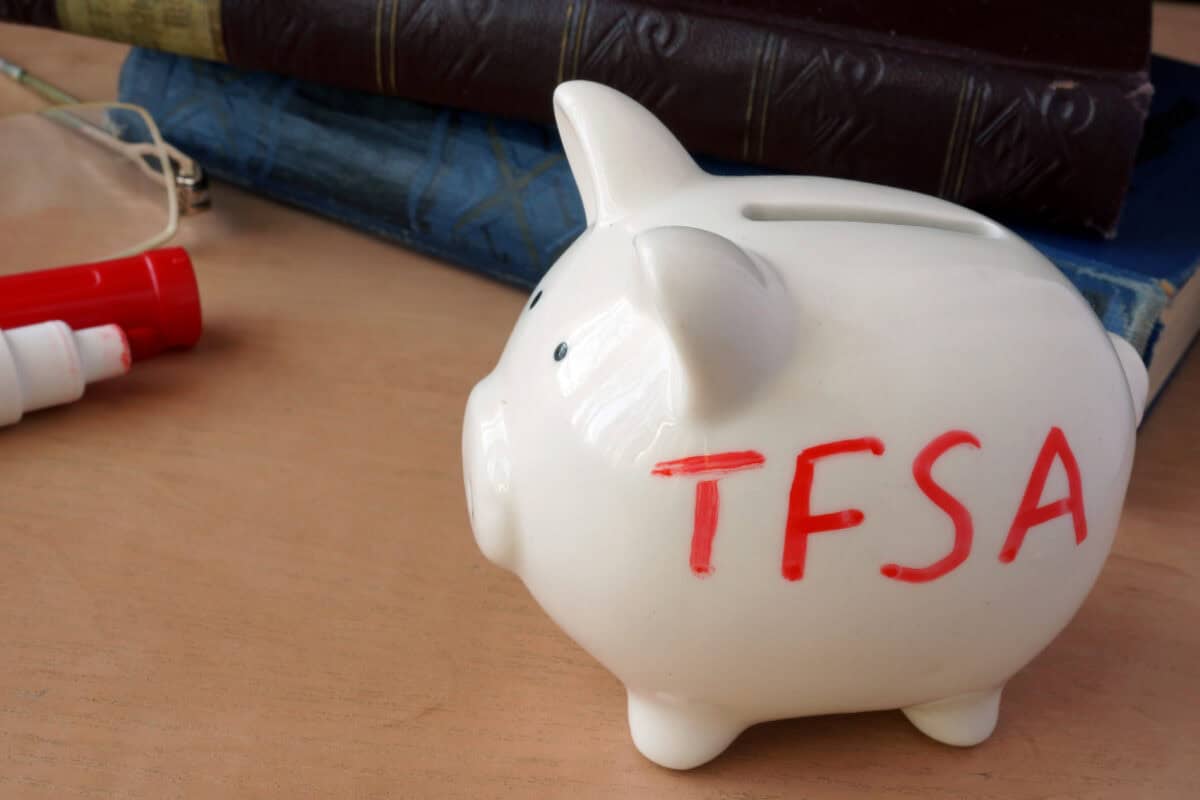
A $1,000 monthly Tax-Free Savings Account (TFSA) paycheque sounds like something reserved for investors who started investing immediately after the account launched in 2009. Well, it isn’t.
The real question is yield. To produce $12,000 annually, a portfolio yielding 4% needs $300,000. At 5%, it needs $240,000. Push that to 6%, and the target falls to $200,000.
Higher income gets you there with less capital. It also usually brings more risk, which is where the calculation gets considerably more interesting.
Source: Getty Images
Start with the target
Here’s the basic math behind those targets.
| PORTFOLIO YIELD | TFSA VALUE NEEDED | ANNUAL INCOME | AVERAGE MONTHLY INCOME |
|---|---|---|---|
| 4% | $300,000 | $12,000 | $1,000 |
| 5% | $240,000 | $12,000 | $1,000 |
| 6% | $200,000 | $12,000 | $1,000 |
| 7% | $171,429 | $12,000 | $1,000 |
That doesn’t mean investors should chase whichever stock happens to flash 9% on the screen. A distribution cut can make that shortcut painfully temporary.
There’s also the contribution-room issue. The 2026 TFSA dollar limit is $7,000. Someone eligible every year since the TFSA launched in 2009 would have accumulated $109,000 of total contribution room before accounting for previous contributions and withdrawals.
Yet a TFSA can grow well beyond $109,000. Investment growth inside a TFSA doesn’t consume additional room. That’s how years of reinvested dividends and capital gains can eventually turn a six-figure contribution history into a considerably larger income machine. So what might that machine own?
SRU
SmartCentres REIT (TSX: SRU.UN) is one option I’d consider as part of a diversified income portfolio. SmartCentres owns 201 Canadian properties, many anchored by Walmart and other value-oriented retailers. Its portfolio also includes offices, rental housing and self-storage, giving the REIT additional ways to squeeze income from its enormous land base.
The retail business remains impressively full. Second-quarter committed occupancy reached 98.1%, while renewed leases produced 6.6% rent growth when anchor tenants were included. Funds from operations (FFO), a useful measure of cash-generating performance for REITs, came in at $0.58 per unit. That provides reasonable coverage for the current $0.15 monthly distribution.
What $1,000 monthly takes
As of writing, SmartCentres trades at about $26.56, with the $1.85 annualized distribution producing a yield of roughly 7%. To generate at least $12,000 annually from SmartCentres alone, an investor would need 6,487 units.
| COMPANY | RECENT PRICE | NUMBER OF SHARES | ANNUAL DIVIDEND | ANNUAL TOTAL PAYOUT | FREQUENCY | TOTAL INVESTMENT |
|---|---|---|---|---|---|---|
| SRU.UN | $26.56 | 6,487 | $1.85 | $12,000.95 | Monthly | $172,294.72 |
That averages almost exactly $1,000 monthly, and because SmartCentres is one of Canada’s monthly dividend stocks, the cash actually arrives monthly rather than as a monthly average in quarterly payments. Still, I wouldn’t put $172,000 into one REIT merely to make the spreadsheet look tidy.
Income needs protection too
SmartCentres trades at roughly 11.5 times annualized Q2 FFO, which looks reasonable beside its nearly 7% yield. The risk is debt. Higher interest expenses already contributed to adjusted FFO per unit slipping to $0.54 from $0.55 during the quarter. Property values, refinancing costs and development spending can also pressure results.
The distribution isn’t guaranteed, either. A $1,000 TFSA paycheque should ideally come from several businesses and sectors rather than one landlord carrying the entire retirement budget on its back.
Bottom line
At a 6% portfolio yield, roughly $200,000 could generate $1,000 per month. Around 7%, the target drops toward $171,000. SmartCentres demonstrates how a high-quality monthly payer can help close that gap, but the better strategy is building the TFSA gradually, reinvesting income and diversifying as the balance grows.
The first $1,000 monthly paycheque may take years to build. Once the TFSA gets large enough, however, the tax-free cash can start doing considerably more of the work.