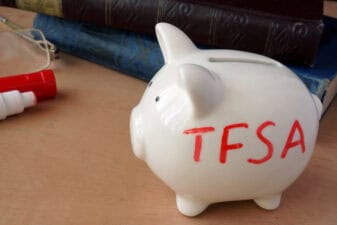
A Tax-Free Savings Account (TFSA) holding cash rarely delivers a frightening surprise. The balance doesn’t plunge after an earnings announcement. Nobody cuts its dividend. Checking the account doesn’t require a deep breath and a calming tea.
Yet a steady balance can hide a shrinking ability to pay for things.
That’s the risk long-term investors can overlook. Keeping money safe from market swings isn’t the same as preserving its purchasing power. Inside a TFSA, years spent earning very little can also mean years of tax-free compounding that never happens.

Source: Getty Images
An “invisible” loss
Imagine leaving $10,000 in a TFSA earning no interest for 10 years. With inflation averaging an illustrative 2.5% annually, that money would buy approximately $7,812 worth of today’s goods. The account would still show $10,000. Your purchasing power would have fallen almost 22%.
Even interest doesn’t automatically solve the problem. If the cash earned 1.5% annually while inflation averaged 2.5%, its purchasing power after a decade would be approximately $9,066. These are examples, not current rate quotes or inflation forecasts.
Cash earning more than inflation can preserve purchasing power. The point is to compare the two rates, not assume every savings account is quietly losing money.
Give the cash a deadline
I’d keep emergency savings and money needed soon in accessible savings or appropriately timed guaranteed investment certificates (GIC). A planned roof replacement shouldn’t depend on whether the TSX is having a pleasant September.
Long-term retirement money deserves a different conversation. If I won’t need it for 10 years or longer, I’d consider a diversified portfolio that includes profitable businesses capable of growing earnings and dividends. The goal isn’t to eliminate uncertainty. It’s to avoid treating a short-term parking spot as a permanent investment strategy.
A bank worth considering
Bank of Montreal (TSX: BMO) is one stock I’d consider for that longer-term portion. Its Canadian banking franchise, U.S. operations, wealth management, and capital-markets businesses provide several sources of earnings.
The latest results show progress. Fiscal third-quarter adjusted earnings reached $3.96 per share, up 22% year over year. However, reported earnings fell to $2.38 per share, largely because of a goodwill-related charges tied to the announced sale of its transportation and vendor-finance businesses.
BMO’s quarterly dividend is $1.71 per share, or $6.84 annualized, representing a yield near 2.8%. A $10,000 allocation would purchase 41 whole shares for $9,941.27 and generate $280.44 annually if the dividend remained unchanged.
That payment isn’t necessarily better than a competitive savings rate. The additional opportunity is earnings growth, which can support future dividend increases and share-price appreciation.
Price still matters
Your alternative to idle cash shouldn’t be an overpriced stock purchased out of impatience. BMO recently traded around 20 times trailing earnings. Its U.S. expansion still needs to deliver better returns, and a weaker economy could increase loan losses. I’d favour a modest position built gradually rather than moving an entire cash balance into one bank.
Diversification across other Canadian dividend stocks and international equities would reduce dependence on BMO’s execution. It wouldn’t prevent market losses. TFSA investment losses also don’t create replacement contribution room, so taking excessive risks inside the account can be particularly costly.
Bottom line
Cash is useful when it has a purpose. The problem begins when “I’m waiting for a better opportunity” becomes a decade-long plan.
I’d protect near-term spending, check whether my cash return beats inflation, and gradually invest genuinely long-term money. BMO could be one component, provided the price and risks fit.
A calming account statement is comforting. A TFSA that can still fund your future is the more important goal.