While Alberta’s mandatory production cuts caused Canadian crude prices to soar, this is only a quick fix with no long-term solution in sight. Both heavy oil benchmark Western Canadian Select (WCS) and light oil price Edmonton Par have more than doubled from record November 2018 lows. This occurred because their differentials to the North American benchmark West Texas Intermediate (WTI) narrowed significantly to be around US$11 and US$4, respectively. That has been a boon for Canadian upstream oil producers, particularly those focused on the oil sands like Cenovus Energy Inc. (TSX:CVE)(NYSE:CVE), which until the production cuts were announced was making a loss on each barrel of bitumen produced.
New solutions being considered
Because of the short-term nature of the solution put in place by Alberta, the provincial government and oil sands industry are considering other longer-term options. Key among these is alleviating the transportation bottlenecks, which along with growing production, saw a record supply localized supply glut emerge in Western Canada by expanding crude by rail transportation. To achieve this, Alberta’s government has begun negotiations to expand the provinces rail network to boost the volume of crude transported by rail by around 120,000 barrels daily over the next three years. While this will go some way to reducing transportation constraints, it will be insufficient to fully address the lack of exit capacity for Canada’s oil producers.
Even record crude by rail shipments in October 2018 of 327,229 barrels, which was 21% or 57,400 barrels daily greater than the previous months, failed to prevent the discount applied to Canadian heavy rising to a record high in October 2018. The key issue weighing on the prices of Canadian crude blends as well as natural gas is a lack of pipeline capacity magnified by growing production. The Canadian Association of Petroleum Producers (CAPP) expects that on average, domestic oil production will expand annually by around 94,000 barrels daily over the next 16 years. Additional production will swamp the new capacity being brought online by expansions of existing pipelines as well as Alberta’s proposed increase to the volumes of crude transported by rail.
Another option being considered by the provincial government is to increase Alberta’s refining capacity. According to analysts, this will have little positive effect because the province already produces more fuels than it consumes, and the pipelines, which transport petroleum products to outside markets are at capacity. By boosting local refining capacity, it solely moves the problem further down the value-chain without dealing with the core problem, a critical lack of capacity on export pipelines that connect the oil patch to crucial U.S. refining markets.
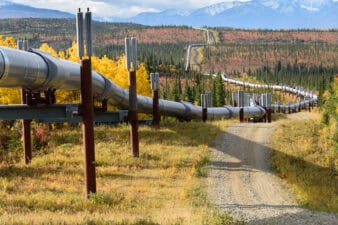
There are no indications of that issue being dealt with anytime soon. There are steep regulatory hurdles to building new pipelines while existing pipeline developments such as Enbridge Inc.’s Line 3 expansion continue to face considerable community and environmental opposition. It also takes substantial amounts of time and capital to construct as well as commission new pipelines, rendering it virtually impossible to expand pipeline capacity overnight. That means there is every likelihood that the wide differential between WCS and WTI will remerge once the production cuts wind down in roughly nine months.
Investor takeaway
This isn’t good news for Cenovus. Since buying ConocoPhillips Co.’s Canadian oil sands assets has become Canada’s third-largest bitumen and heavy oil producer that makes roughly 76% of its total petroleum output. Should the differential between WCS and WTI widen once Alberta’s production cuts wind down, Cenovus’ profitability will once again decline. That is evident from its third quarter 2018 results; despite WTI averaging US$66.75 a barrel, Cenovus only reported a netback – a key measure of profitability – before commodity hedges of around US$19 per barrel produced. This was a significant contributor to its quarterly net loss from continuing operations of $242 million compared to a profit of $275 million a year earlier.
Until the lack of pipeline capacity is addressed, it’s likely that any strategies implemented by Alberta and the oil sands industry will only have a temporary effect on narrowing the differential between Canadian oil prices and WTI. That makes most oil sands producers, especially those with minimal or no refining capacity unattractive investments.