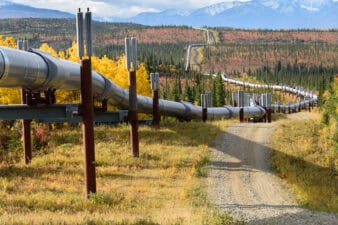
The stock market appears to be expensive. There’s value to be found, though. You can probably find the most value in energy stocks, as the investor sentiment is still pretty negative in the space. Here are a few energy stocks you can explore.
Suncor stock
It could be a good time to pick up some Suncor (TSX: SU)(NYSE: SU) shares, as the energy stock has corrected about 25% from its high in May. In late July, when management reported its second-quarter (Q2) results, it provided an updated outlook for this year.
First, it expected its income tax expense to climb about 17% to roughly $1.35 billion. Second, it projected its production to reduce approximately by a third at Fort Hills, which would increase the cash operating costs per barrel by about 46% to roughly $39.50 at that mine.
The energy stock’s correction already reflects these changes. Potentially, the value stock can climb more than 50% over the next 12 months from the current levels of about $23 per share. Meanwhile, it also pays a 3.6% dividend yield that is well covered by cash flow. Its trailing-12-month (TTM) payout ratio is about 52% of free cash flow.
Whitecap Resources
Suncor stock isn’t the only energy stock that has had a correction lately. So has Whitecap Resources (TSX: WCP), which is down about 20% from its high earlier this year. The company reported positive Q2 results with record production and a higher production outlook for the year while keeping its capital spending steady.
Its TTM operating cash flow was 12% higher than the normalized levels in 2019, while its TTM free cash flow almost doubled. Part of that is the combination of Whitecap Resources with TORC Oil and Gas, through which it was able to draw some synergies. Indeed, year to date, its funds flow more than doubled to $454 million. On a per-share basis, funds flow climbed almost 55%, which was still a significant increase.
The smaller cap energy stock appears to be a bigger bargain than Suncor stock. The value stock could climb more than 70% over the next 12 months from the current levels of about $5 per share. Furthermore, it also pays a slightly higher yield of 3.9% dividend yield that is well covered by cash flow. Its trailing-12-month payout ratio is only 19% of its free cash flow generation.
Renewable energy stocks
If you’re not a fan of Suncor or Whitecap, consider renewable energy stocks that are trading at a value. Both Brookfield Renewable Partners (TSX: BEP.UN)(NYSE: BEP) and Northland Power (TSX: NPI) are worth further investigation.
Their stocks have dipped about 15% and 16%, respectively, from their highs this year. If they revisit their recent highs, you’re looking at a near-term upside potential of about 18% and 20%, respectively, which would be decent. Additionally, they also offer yields of almost 3% that will add to the total returns.
Notably, BEP has a track record of increasing its cash distribution for about a decade. So, you can expect another dividend hike of at least 5% in February.
In the first half of the year (H1), BEP only witnessed its funds from operations per unit (FFOPU) rising 2.6% year over year (YoY). Consequently, its H1 payout ratio was about 77%. However, management expects the normalized FFOPU, based on the estimated long-term average generation, to be higher. The H1 normalized FFOPU climbed 21% YoY to US$0.92, which would imply a normalized FFO payout ratio of about 66% for the period.
Investors should not view Northland Power’s results on a quarterly or even annual basis. For example, its cash flow per share dropped 8% in 2015 but jumped a whopping 91% in 2016. Look at its long-term results instead. It has been executing its growth strategy well, which has driven long-term cash flow growth.
In turn, the cash flow growth has nudged its stock price higher over time. Since 2015, the dividend stock has delivered annualized returns of about 19%. It has simply outperformed the market!