Welcome to a series where I break down and compare some of the most popular exchange-traded funds (ETFs) available to Canadian investors!
Canadian investors taking a passive approach to buying domestic stocks generally default to the tried-and-true S&P/TSX 60 Index, but the market doesn’t end there. Beyond the TSX 60, there are at least another few hundred small- and mid-cap Canadian stocks worth investing in.
Both Vanguard and BlackRock provide a set of low-cost, high-liquidity, CAD-denominated ETFs for tracking the overall Canadian stock market. The two tickers up for consideration today are iShares S&P/TSX 60 Index ETF (TSX:XIC) and Vanguard FTSE Canada All Cap Index ETF ETF (TSX:VCN).
Which one is the better option? Keep reading to find out.
XIC vs. VCN: Fees
The fee charged by an ETF is expressed as the management expense ratio (MER). This is the percentage that is deducted from the ETF’s net asset value (NAV) over time and calculated on an annual basis. For example, an MER of 0.50% means that for every $10,000 invested, the ETF charges a fee of $50 annually.
XIC has an MER of 0.05% compared to VCN at 0.06% The difference here is literally $1 on a $10,000 portfolio, which is not worth fretting over. Still, if we had to pick a winner, it would be XIC by a tiny margin, but, honestly, 0.01% is not worth agonizing over.
XIC vs. VCN: Size
The size of an ETF is very important. Funds with small assets under management (AUM) may have poor liquidity, low trading volume, high bid-ask spreads, and more risk of being delisted due to lack of interest.
XIC currently has AUM of $10.67 billion, whereas VCN has AUM of $5.064 billion. Although both are highly liquid and more than sufficient for a buy-and-hold investor, XIC is clearly the more popular one at this time.
XIC vs. VCN: Holdings
Both ETFs have nearly identical sector weights, with over 40% of underlying holdings in the financial and energy sectors, which is typical for the Canadian stock market.
XIC and VCM share the same top 10 holdings, with stocks like Shopify, Royal Bank, Toronto-Dominion Bank, Enbridge, Bank of Nova Scotia, Canadian National Railway, and Brookfield Asset Management dominating.
However, there are some differences in the indexes each ETF tracks. While VCN tracks the FTSE Canada All Cap Index, XIC tracks the S&P/TSX Capped Composite Index.
These indexes have slight differences that shouldn’t affect performance too much but are still notable. Firstly, XIC puts caps on the weightings of each underlying stock. This is to prevent any individual stock from getting so large as to dominate the index. Secondly, XIC has more holdings at 241 vs. 183 for VCN.
XIC vs. VCN: Historical performance
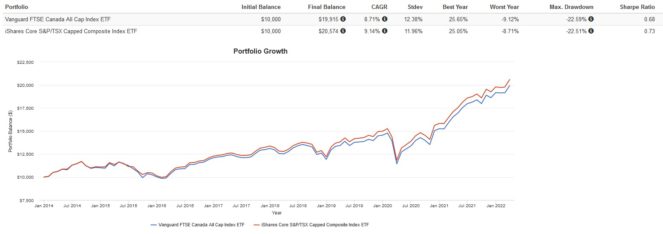
A cautionary statement before we dive in: past performance is no guarantee of future results, which can and will vary. The portfolio returns presented below are hypothetical and backtested. The returns do not reflect trading costs, transaction fees, or taxes, which can cause drag.
Here are the trailing returns from 2014 to present:
Here are the annual returns from 2014 to present:
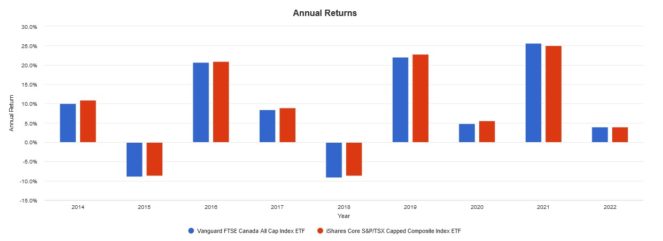
Both ETFs have virtually identical performance, with XIC having a very slight edge. I chalk this up to the fact that XIC held more stocks that may have outperformed in the last few years. Over time, this difference is likely to disappear.
The Foolish takeaway
If I had to pick and choose one ETF to buy and hold, it would be XIC due to a very slightly lower MER, larger AUM, and higher number of holdings. However, if you’re partial to Vanguard, VCN is an excellent choice as well. Best of all, because each ETF tracks a different index, you can potentially use one to tax-loss harvest the other in a taxable account.