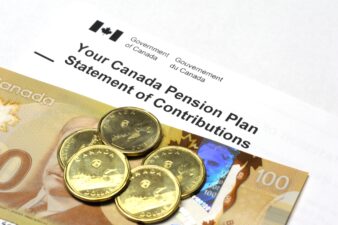
The Canada Pension Plan (CPP) is a crucial lifeline for many Canadian retirees. Providing a modest amount of inflation-indexed income, the program is key to keeping the bills paid.
Unfortunately, CPP is rarely enough to pay all of a person’s bills. In Toronto, the average rent for a one bedroom apartment is $2,400 per month. That’s more than the highest possible monthly CPP benefit, which is $1,855 per month for those taking benefits for the first time at age 70.
However, there are some situations where you can make enough CPP income to live off of. If you live in St. John’s, Newfoundland, for example, you can typically find a place for less than $1,000 per month. Likewise, seniors’ living homes are typically subsidized, resulting in lower monthly costs for those who live in them. Finally, if you own your property, your total expenses will be lower than those of a person who has a $500,000 mortgage. In cities where property taxes are minimal, you can probably cover your home expenses with a maxed-out CPP benefit.
How much CPP you need to live off of
In the preceding paragraphs, I outlined some scenarios in which a person could conceivably cover all of their bills using CPP alone. Your own situation will likely differ from these, so you need to find out your own cash flow needs. It’s best to speak to a financial adviser about this, but in general you’ll need to tally up:
- Rent.
- Utilities (if not included in rent or condo fees).
- Telecom bills (phone, internet, cable).
- Groceries.
- Transportation.
- Discretionary spending.
When you add all of these up, you’ll probably find that they exceed the absolute maximum CPP benefit of $1,855 per month. To return to St. John’s for a minute: MPA Magazine says that you can find a one bedroom there for $880 per month. That’s certainly lower than what you’d pay elsewhere. But throw on a $400 monthly grocery bill, $150 in internet and phone service, $250 in utilities, and $200 in transportation costs, and you’re at $1,880 per month in expenses. That’s more than the $1,855 that the CPP pays out if you earn the maximum pensionable amount and delay taking benefits until age 70! Plus, we haven’t even factored in taxes yet.
CPP taxes
CPP benefits are taxable like any other form of income. You don’t have to pay any taxes on the first $15,000 you earn. If the typical $700 CPP cheque is all the income you’re earning, you won’t pay any taxes on it. If, however, you’re bringing in the maximum $1,855 cheque, then you’ll have about $7,260 in taxable income. A 20% tax on that is $1,452, so there goes the idea of paying all of your bills using just CPP benefits.
How to supplement your CPP income
If you want to supplement your income in retirement, you’ll have to invest your money. Banks like the Toronto-Dominion Bank (TSX:TD) have plenty of ways for you to earn dividends and interest in retirement. TD specifically has a common stock you can buy at a 4.5% dividend yield; a number of preferred shares; GICs yielding 5%; and finally, savings accounts that don’t have much yield but do allow you to maximize your spending flexibility. If you spread your money across stock index funds, individual stocks like TD, GICs and savings accounts, you could probably earn 3% to 4% a year in interest/dividends, without taking on a lot of risk. Also, banks like TD employ financial advisers who can help you with budgeting as well as investments, so be sure to speak with one of them as well.