



As stock market volatility spikes globally, the TSX is currently defined by a delicate balancing act. The Bank of Canada helped by holding the policy rate steady at 2.25% for the second time this year, emphasizing a wait-and-see approach as inflation cooled to 1.8%. However, Middle East tensions, which sent energy prices on a rollercoaster, induce inflationary pressure and amplify stock market volatility, even in Canada. Economic “weather” patterns remain unpredictable, and we have to continue investing accordingly.
All-weather stocks, those that continue to thrive financially through economic cycles, can form your survival strategy for sustained volatility in 2026, more so as team Canada prepares for tough Canada–United States–Mexico Agreement (CUSMA) trade renegotiations in July. Fortis (TSX: FTS) stock, the Canadian National Railway (TSX: CNR), and Canadian Natural Resources (TSX: CNQ) are three all-weather stocks Canadian investors can confidently buy for long-term financial stability. Let’s see why.

Source: Getty Images
Fortis stock
Canada-based North American electric and gas utility Fortis is a definitive defensive stock for any Canadian’s retirement investment portfolio. Fortis stock’s revenue, earnings, and cash flow are largely regulated, predictable, and remain largely stable through economic cycles. This inherent resilience allows Fortis to keep raising the quarterly dividends for its stockholders, a tradition the utility has sustained for 52 consecutive years and counting.
In February 2026, the utility reported solid 2025 annual net earnings of $1.7 billion, or $3.53 per share on an adjusted basis, a performance that could be amplified in 2026 through 2027 as potential earnings per share (EPS) exceed the $4 level, supported by a robust capital investment plan.
Fortis is currently executing its largest-ever five-year capital expenditure plan, a $28.8 billion all-weather offensive running through 2030. This investment may drive 7% annual rate base growth, which in turn supports the Canadian utility’s guidance for 4% to 6% annual dividend increases. Dividends do the heavy lifting for shareholder returns.
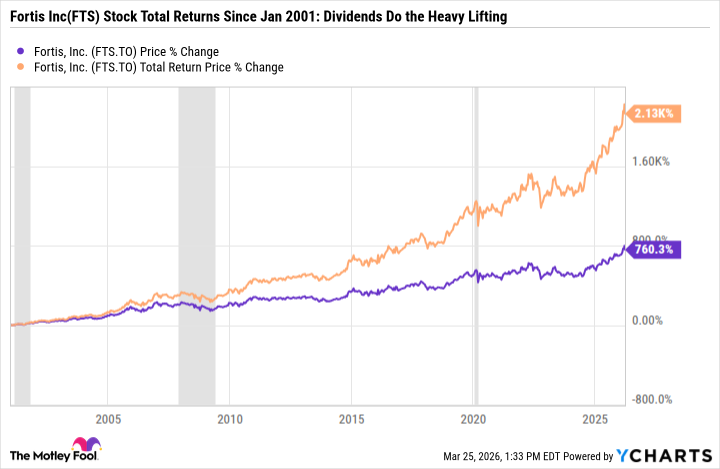
The Fortis stock dividend currently yields 3.4% annually. Given sustained dividend growth through the past three recessions since 2001, Fortis’s dividend amplified a 760% capital gain on FTS stock into a 2,130% total return.
Canadian National Railway stock
The Canadian National Railway acts as an irreplaceable toll road for the North American economy. Whether the economy is booming or merely chugging along, the transport of grain, potash, and consumer goods remains non-negotiable as railroads remain one of the cheapest modes of transport to date. CNR stock is a source of wealth stability for long-term-oriented portfolios. Management has demonstrated the ability to contain costs and sustain respectable operating margins during rising cost environments, and this has helped sustain 30 consecutive years of dividend growth.
The current CNR stock dividend yields 2.6% annually. Make no mistake, the yield appears low because other investors are willing to bid high for its safety, given an earnings payout rate under 50%.
Why should you buy today? Down 8% during the past month, CNR stock is a steady, resilient and well-insulated defensive stock investors can buy on the dip right now and hold for decades to come. Dividend growth and stock repurchases may amplify long-term total returns.
Canadian Natural Resources
Canadian Natural Resources stock is one hot energy stock to buy today as energy markets soar. It’s Canada’s largest oil and gas producer, boasting low-cost, low-decline assets that could sustain current production for over three decades, non-stop. CNQ can comfortably break even and sustain its generous dividends at oil prices in the low US$40s – its operations remain profitable during low oil price environments, and they become insanely profitable and cash flow rich when oil spikes, such as the current one, lifting prices towards triple digits per barrel.
High oil prices leave Canadian Natural Resources with boatloads of cash to deploy in accretive acquisitions, and management uses part of it to repay debt and fortify the balance sheet, repurchase shares, and raise dividends, like it has done for 26 years now.
CNQ stock’s recent 46.4% year-to-date surge may have reduced its dividend yield to 3.7%, but management may raise dividends substantially if oil holds higher for longer. CNQ raised dividends at an average rate of 21.6% over the past five years, and commits to allocate up to 100% of free cash flow to shareholder returns once it reaches set net debt targets.
High oil accelerates CNQ’s achievement of reaching net debt targets. Buy for momentum.







