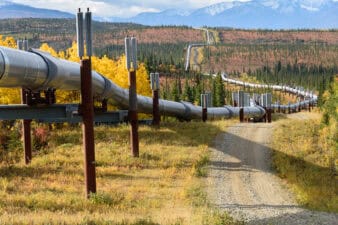
A company helping deliver energy to your home can also help pay the bills. The appealing part is getting cash without selling shares every month. The less attractive part is building the holding first. At the current payment and recent closing price, roughly $42,600 in one pipeline stock could produce a $200 monthly average, with the cash arriving quarterly.

Source: Getty Images
Build the annual paycheque
A $200 monthly average means $2,400 a year. For a stock paying every three months, the practical target is about $600 each quarter. I’d collect the dividends in cash and make monthly transfers from that balance, giving my spending a smoother schedule than the company’s payment calendar.
Enbridge (TSX: ENB) makes that calculation possible with a quarterly dividend of $0.97 per share. Its annualized $3.88 payment yields about 5.6% at the recent closing price of $68.82. That’s substantial starting income, so the next step is making sure the business has room to pay it.
Earn from the network
Enbridge operates oil and natural gas pipelines, gas utilities, and other energy infrastructure. Much of its earnings relies on regulated returns or contracted service, giving it a different relationship with oil prices from a producer selling the commodity. Customers pay for access to infrastructure they need to move and use energy.
Utilities and export facilities needing more gas capacity offer growth opportunities. Enbridge’s second-quarter update described new pipeline connections and expansions supported by customer demand. New assets can add earnings once operating, although construction spending comes before those earnings arrive.
For the dividend, management reaffirmed 2026 distributable cash flow of $5.70 to $6.10 per share. This is the company’s cash-flow measure after adjustments including maintenance spending and financing costs. The $3.88 annual dividend uses roughly 64% to 68% of that range, leaving some cash beyond the payment.
The holding in dollars
Reaching at least $2,400 annually requires 619 whole shares at the current payment. Using the recent close, and excluding trading fees, here’s the investment required.
| COMPANY | RECENT PRICE | NUMBER OF SHARES | ANNUAL DIVIDEND | ANNUAL TOTAL PAYOUT | FREQUENCY | TOTAL INVESTMENT |
|---|---|---|---|---|---|---|
| ENB | $68.82 | 619 | $3.88 | $2,401.72 | Quarterly | $42,599.58 |
That holding produces $600.43 each quarter, averaging $200.14 monthly. A $42,600 budget leaves $0.42 uninvested. One fewer share would produce $2,397.84 annually, just below the target, which is why rounding to whole shares changes the required purchase.
Someone starting with $10,000 could buy 145 shares for $9,978.90. The current dividend would pay $562.60 annually, averaging $46.88 monthly. That’s already a contribution towards regular bills, with room to build.
Reinvesting while adding savings can build the share count before the income is needed. Dividend increases could help too, with future increases depending on earnings and the board’s decision. I’d use dividend investing to build ownership over time instead of treating the full target as an all-or-nothing starting requirement.
Keep one payer in proportion
The main risks are debt, project costs, and regulatory delays. Higher borrowing costs can absorb cash that might otherwise fund growth or a larger dividend. A covered payment doesn’t protect the share price, especially when interest rates elsewhere look attractive.
I’d also avoid putting an entire retirement account into one energy company. If $42,600 would dominate the portfolio, I’d build part of this income from other sectors. The goal is a useful paycheque that can survive a difficult year for one business.
Holding the shares inside a Tax Free Savings Account (TFSA) generally shelters Canadian dividends and withdrawals from tax. A new deposit must fit your personal available room, which can include unused room from earlier years. Withdrawals generally return as contribution room the next calendar year. Outside the TFSA, taxes reduce the amount available to spend.
Bottom line
I’d build towards this holding gradually as one part of a diversified income account. Starting with a smaller share count still puts business cash to work for you. Further contributions, reinvestment, and affordable dividend growth can steadily move that quarterly payment closer to the household bill you want it to cover.