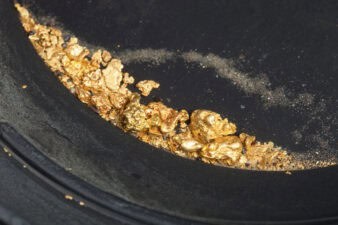
Barrick Gold Corp. (TSX: ABX)(NYSE: ABX) and Goldcorp Inc. (TSX: G)(NYSE: GG) are battling their way through a tough environment. Gold prices have dropped nearly 40% from the September 2011 high of $1,921.50 per ounce and now trade below $1,200.
Given the strengthening U.S. dollar and a negative outlook for gold in 2015, you might wonder why anyone would consider buying gold companies right now. Well, that’s why some investors are called contrarians.
Let’s take a look at both Barrick and Goldcorp to see if one is a better choice at the moment.
Barrick Gold Corp.
Barrick is sitting on US$13.1 billion in debt, its shares are down more than 30% in the past three months, and a game of musical chairs at the senior management level has investors wondering if the company will ever get back on track.
The debt load is scary given Barrick’s current market cap of US$13.8 billion, but most of the obligations are longer-term. In its Q3 2014 earnings statement, Barrick said only US$200 million of the debt will mature in 2015 and less than US$1 billion is due by the end of 2017. The company finished the third quarter with US$2.7 billion of cash.
For the time being, the company has ample liquidity.
Barrick is making progress on driving efficiency into its operations. Despite the difficult market conditions, Barrick reported Q3 adjusted net earnings of $222 million. The company’s average all-in sustaining costs (AISC) guidance for 2014 now sit at $880 to $920 per ounce for 2014.
The company said its top five mines produced 1 million ounces in the third quarter with the AISC coming in at $696 per ounce.
One other concern for investors sits on the copper side. Barrick’s Lumwana copper project could be at risk if the Zambian government implements a proposed 20% royalty on the mine. The current rate is 6%.
Goldcorp Inc.
Goldcorp’s stock has also taken it on the chin recently. The shares are down about 26% since the beginning of September.
The company’s balance sheet looks better than Barrick’s. Goldcorp finished Q3 2014 with US$3 billion in total debt and held cash or cash equivalents of US$376 million. The market cap is about US$16 billion. The company says its 2014 AISC should be $950 to $1,000 per ounce.
Goldcorp has a number of new projects that are ramping up production and should boost cash flow in the coming years.
The Cerro Negro mine in Argentina started production in July. The project is operating on schedule and within budget guidance. Goldcorp bought Cerro Negro in 2010 and exploration efforts have resulted in a 100% increase in proven and probable reserves that now sit 5.74 million ounces.
The Éléonore mine is located in Canada and just produced its first gold in October. Commercial production should begin in the first quarter of 2015 with a target annual output of 600,000 ounces. Éléonore has proven and probable gold reserves of about 4 million ounces.
Goldcorp pays an annualized dividend of US$0.60 that yields about 3%.
Which should you buy?
Barrick is undergoing a lot of changes and new investors might want to wait to see how the incoming CFO, Shaun Usmar, decides to tackle the debt issue.
Forecasts for a year-end gold price of $1,050 are still being watched and some analysts say the price could head toward $800 in 2015 if the U.S. dollar continues its ascent. If you sit in the camp that believes gold will trend higher through 2015 and beyond, then it is probably a good time to take a small position. With Goldcorp, you have the benefit of a 3% yield, good production growth, and a solid balance sheet.
Both Barrick and Goldcorp are risky bets in the current environment and some investors prefer to balance out their contrarian holdings with more stable stocks. If you are looking for a less volatile option for your portfolio, you might want to read the following free report.