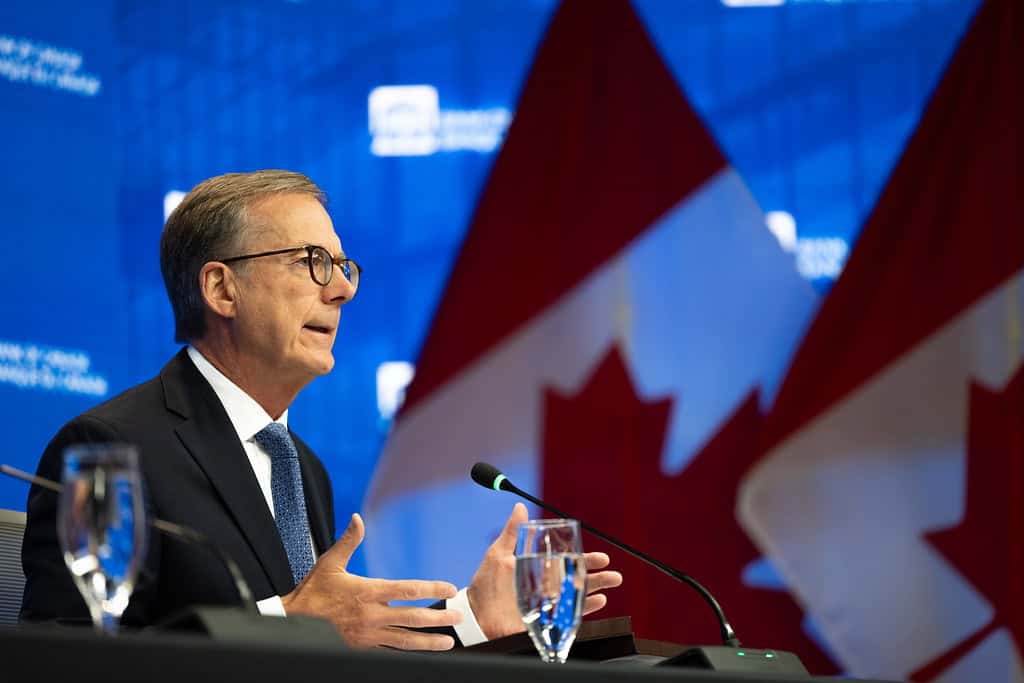
The Bank of Canada held its policy rate at 2.25% on March 18 — the second hold of 2026 — with Governor Tiff Macklem flagging that the economy continues to face heightened uncertainty from U.S. trade policy and geopolitical risks and that the war in Iran has now added a new layer of volatility.
Canada’s picture is genuinely complicated. Inflation eased to 1.8% in February, core measures are close to 2%, and the economy is expanding again, but at a slower pace than had been forecast in January, with the labour market soft and exports showing ongoing weakness.
Macklem was blunt about the dilemma: raising rates to slow inflation risks further weakening the economy, while easing to support growth risks pushing inflation above target.
For TFSA investors, that backdrop is actually useful information. It means the bank is on hold, rates are not heading sharply higher, and the economy is grinding forward rather than collapsing. That is a reasonable environment for investors to consider a mix of income, resilience, and growth — rather than chasing a single narrow theme. A dependable bank, a discounted income name, and a long-term growth story look like the right ingredients right now.
Toronto-Dominion Bank
Toronto-Dominion Bank (TSX: TD) is an easy place to start. It’s one of Canada’s largest banks, with retail banking, wealth management, insurance, and capital markets operations on both sides of the border. Over the last year, the big story has been cleanup and reset. Raymond Chun took over as CEO, TD kept working through its U.S. anti-money-laundering remediation, and it sold its Charles Schwab stake to free up capital for buybacks and business investment.
The numbers came in strong. TD reported first-quarter 2026 adjusted earnings of $4.2 billion, or $2.44 per share — a record, beating analyst estimates of $2.26 and up 20% from the same period last year. The bank also launched a new CA$7 billion share buyback program. At a recent price near $128.66, the quarterly dividend of CA$1.08 — or CA$4.32 annualized — puts the yield around 3.4%, with the next ex-dividend date on April 9. For a TFSA, TD fits because it offers a dependable dividend, financial strength, and room for capital returns as the reset phase fades.
BCE
BCE (TSX: BCE) is a very different idea. It’s Canada’s largest communications company, offering wireless, internet, and communications services that people keep paying for. The last year has been rough, with slower growth, pressure in legacy media, and the need to keep its balance sheet under control. It reset investor expectations by cutting its common share dividend to $0.4375 quarterly, which was painful in the moment but arguably necessary.
[Related: What’s going on with BCE’s dividend?]
Its latest results show why investors are still debating it. BCE reported fourth-quarter 2025 operating revenue of $6.4 billion, adjusted EBITDA of $2.67 billion, and adjusted EPS of $0.69. For 2026, management is targeting free cash flow growth of 4% to 10%, with annualized common dividends now at $1.75 per share. At a recent price near $35.09, the yield sits around 5% — a reasonable income yield from a business with deleveraging momentum and a more sustainable payout structure. This is not a fast grower, and that is the risk. But in a TFSA, BCE can work as a patient income investment as long as management keeps executing.
MDA
MDA Space (TSX: MDA) is the growth engine of this group. It’s a Canadian space technology company with exposure to satellites, robotics, and geo-intelligence, aka the kind of stock that belongs in a TFSA for a very different reason than TD or BCE.
The earnings have been impressive. MDA reported record 2025 revenue of $1.633 billion, up 51%, record adjusted EBITDA of $324 million, up 49%, and fourth-quarter adjusted diluted EPS of $0.45, up 60.7%. It ended the year with a $4 billion backlog and guided for 2026 revenue of $1.7 billion to $1.9 billion.
Earlier this month, MDA completed a US$300 million IPO on the NYSE, broadening its investor base and raising capital to accelerate growth. And the company launched 49North, a new wholly-owned subsidiary focused on delivering defence capabilities for Canada that’s directly aligned with the government spending tailwind. At a recent price near $34, MDA has risen significantly from its 52-week low of $20.85, so the entry point matters. But for a long-term TFSA investor, the combination of a record backlog, a new U.S. listing, and an expanding defence arm makes MDA one of the more compelling Canadian growth stories right now, and one that I think is worth paying up for.
Bottom line
Put the three together and the TFSA idea gets compelling. TD brings stability and dependable income from one of Canada’s best-run banks. BCE brings contrarian income with a recovery thesis and a more sustainable dividend structure. MDA brings a growth runway backed by a record backlog, a new NYSE listing, and expanding defence exposure.
Here’s what kind of income investors could earn from $7,000 each in TD and BCE:
| COMPANY | RECENT PRICE | NUMBER OF SHARES YOU COULD BUY WITH $7,000 | ANNUAL DIVIDEND | TOTAL ANNUAL PAYOUT ON A $7,000 INVESTMENT | PAYOUT FREQUENCY |
|---|---|---|---|---|---|
| TD | $126.87 | 55 | $4.32 | $237.60 | Quarterly |
| BCE | $35.06 | 199 | $1.75 | $348.25 | Quarterly |
With the Bank of Canada signalling a slower but steady backdrop, I would not try to be too clever. I would build around quality, value, and growth together, then let the TFSA do what it does best: compound quietly in the background.