A $1 million Registered Retirement Savings Plan (RRSP) sounds like retirement success. However, then the withdrawals begin.
Money entering an RRSP generally earns a tax deduction. Investments can compound tax-deferred for decades. The bill arrives when money comes out, and a large account can eventually create more taxable income than a retiree expected.
That makes the size of the RRSP only half the retirement calculation. The other half is how quickly it has to come back out.

Source: Getty Images
The switch at 71
An RRSP can’t remain an RRSP forever. By December 31 of the year you turn 71, you generally need to withdraw the money, purchase an eligible annuity, or convert the account into a Registered Retirement Income Fund (RRIF).
The RRIF is the common choice because investments can remain inside the account and continue growing tax-deferred. The big change arrives the following year. RRIFs require annual minimum withdrawals. For someone aged 72, the standard factor is 5.40%.
Here’s what that might look like.
| RRIF VALUE | AGE-72 MINIMUM | MONTHLY AVERAGE |
|---|---|---|
| $250,000 | $13,500 | $1,125 |
| $500,000 | $27,000 | $2,250 |
| $750,000 | $40,500 | $3,375 |
| $1,000,000 | $54,000 | $4,500 |
That income is taxable. No tax generally needs to be withheld from the RRIF minimum, which can create another surprise at tax time. Withdrawals above the minimum are generally subject to withholding tax, but withholding isn’t necessarily the final tax bill.
Income can collide
Now add Canada Pension Plan (CPP) payments, Old Age Security (OAS), an employer pension, investment income, or part-time earnings. A large RRIF can push total taxable income higher quickly. For 2026 income, the estimated OAS recovery tax threshold is $95,323. Income above that level can trigger a 15% recovery tax on the excess.
A retiree withdrawing $54,000 from a $1 million RRIF doesn’t automatically lose OAS. The withdrawal simply becomes one more taxable income source competing for the same threshold. That said, there are planning tools. Canadians aged 65 or older may be able to split up to 50% of eligible RRIF income with a spouse or common-law partner. Eligible RRIF income can also qualify for the federal pension income amount.
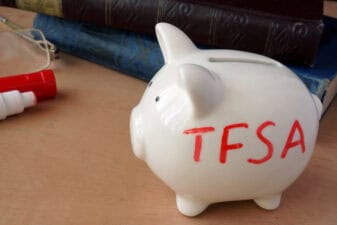
Surplus after-tax withdrawals can potentially be moved inside a Tax-Free Savings Account (TFSA) when contribution room exists, where future eligible growth and withdrawals remain tax-free. Then comes the investment question. What should remain inside the RRIF while those withdrawals continue?
BCE
I’d want a mix of investments instead of forcing the account to produce every dollar through dividends. One income stock I’d investigate is BCE (TSX: BCE). BCE owns Bell Canada’s wireless, internet, television, media, and communications infrastructure businesses. The stock’s old income story took a painful reset in 2025 when the company reduced its annual dividend to $1.75.
That cut also lowered the cash BCE needs to send to shareholders. Second-quarter revenue increased 1.5%, while adjusted earnings per share (EPS) rose 3.2% to $0.65. Cash flow from operating activities increased 11% to $2.16 billion. Free cash flow fell to $1.04 billion as BCE spent more on Bell AI Fabric data centres and Ziply Fiber’s U.S. fibre network.
At $30.53, the $1.75 annual dividend produces a yield around 5.7%. That can help provide retirement cash, but I’d treat it as one piece of a diversified collection of Canadian dividend stocks, not a substitute for a withdrawal plan.
Bottom line
BCE still carries substantial debt and faces intense telecom competition. What’s more, Ziply’s capital requirements could be a reason deleveraging may take longer, even after the dividend cut.
That’s all to say that a high yield doesn’t remove those risks. No matter what, a large RRSP eventually stops being a savings vehicle and becomes a taxable income machine. At age 72, a $1 million RRIF could require a $54,000 minimum withdrawal before CPP, OAS, pensions, or other income enter the calculation.
That’s why retirement planning shouldn’t stop at “how much can I save?” The better question is how you want all that money to come back out.