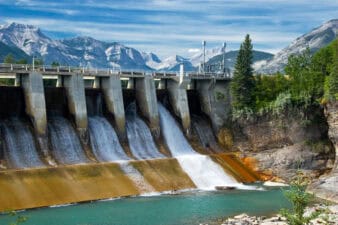
Brazil’s election could move stocks, currencies and commodities in a single afternoon. Yet a hydroelectric dam will still be sitting in the river the next morning.
That distinction makes infrastructure an interesting way to approach political uncertainty. Rather than guessing which Brazilian stock gets the biggest election-day pop, investors can own assets designed to produce cash over decades. Brookfield Renewable Partners (TSX: BEP.UN) offers that route.

Source: Getty Images
Brazil is only one piece
Brookfield Renewable owns hydroelectric, wind, solar, storage and other power assets around the world. Brazilian hydro is part of that portfolio, but it’s nowhere near the entire business.
In the latest quarter, Brazilian hydro generated US$55 million of proportionate revenue versus US$1 billion across the platform, working out to only about 5.4%.
The figure doesn’t include every Brazilian asset, but it demonstrates an important point. That buying Brookfield Renewable isn’t equivalent to betting the portfolio on Brazil’s runoff election. Diversification can cushion country-specific surprises. It can also dilute the benefit if Brazil suddenly becomes the market’s favourite place on Earth.
Cash flow needs separating
Second-quarter funds from operations reached US$421 million, or US$0.62 per unit. Funds from operations (FFO) is useful because it gives investors another view of operating cash generation beyond accounting earnings.
Still, the quarter benefited from asset recycling. Brookfield Renewable regularly develops, improves and sells assets, then reinvests the proceeds. That can create value, but investors shouldn’t mistake every asset-sale gain for endlessly repeatable operating income.
That becomes especially important for Canadian dividend stocks where investors depend on the payout continuing. BEP.UN currently pays US$0.39 quarterly, or US$1.57 annually. For Canadian investors, the actual Canadian-dollar income changes with the exchange rate.
At writing, that comes to a 5.5% dividend yield coming out at about $2.22 annually. Here’s what that might look like from a $10,000 investment at writing.
| COMPANY | RECENT PRICE | NUMBER OF SHARES | ANNUAL DIVIDEND | ANNUAL TOTAL PAYOUT | FREQUENCY | TOTAL INVESTMENT |
|---|---|---|---|---|---|---|
| BEP.UN | $40.36 | 247 | $2.22 | $548.34 | Quarterly | $9,968.92 |
Now ,of course, those aren’t forecasts. Dividends can change, and there are still returns to consider. Yet this simply shows why Canadian investors shouldn’t look at the U.S.-dollar distribution and assume their spending income is fixed. Holding BEP.UN inside a Tax-Free Savings Account (TFSA) can generally shelter eligible investment growth from Canadian tax, but account type and partnership distributions deserve attention.
Bottom line
There are always risks to consider. Brazilian regulation, hydrology, and currencies can affect local returns. Across the larger business, higher interest rates and rising construction costs can make new renewable projects less attractive.
Brookfield Renewable also needs to keep finding assets worth building, operating and eventually recycling. That’s a more complicated investment than simply owning a hydro plant and waiting for rain.
Brazil’s election provides a timely reason to look at Brookfield Renewable. It isn’t the reason I’d own it. Brazilian hydro represents only a slice of a much larger global platform. I’d buy for diversified power assets, cash-flow growth and disciplined reinvestment. If Brazil becomes a more attractive market after the election, that can help. The investment still needs to work after the campaign signs disappear.