Transitioning from earning active employment income to living off a pension and an investment portfolio is one of the most critical financial shifts a retiree will ever make. While the willingness to take on capital risk naturally declines in retirement, the need for reliable, recurring cash flow increases dramatically. Relying on liquidating equity positions every month to pay for monthly living expenses can be nerve-wracking during periods of market volatility. Fortunately for Canadian retirees who want to make passive income without losing sleep over market swings, the low-risk fixed-income space offers a compelling investment option through the Purpose Global Bond Fund (TSX: BND).

Source: Getty Images
A smarter way to make monthly passive income in retirement
Incepted in 2015, the Purpose Global Bond Fund is an exchange-traded fund (ETF) structured specifically as a stable cash-flow generating portfolio. The fund currently pays a regular monthly distribution of $0.08 per share, translating to an attractive annualized dividend yield of roughly 6%.
The monthly dividend ETF’s track record of payout stability and dividend growth is what makes the BND particularly appealing for retirees looking to make passive income. Monthly distributions have expanded from $0.05 per share in early 2020, even navigating a raise to $0.06 during the height of the pandemic, indicating the portfolio design expertise of its manager, the strength and resilience of its underlying holdings, and proving the effectiveness of its all-weather income strategy.
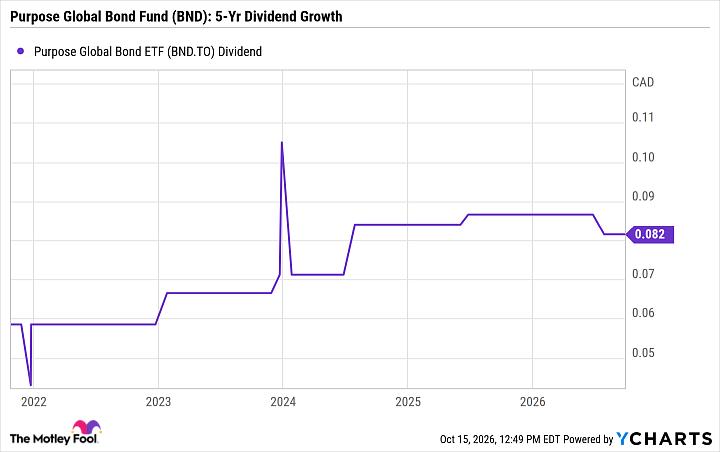
BND Dividend data by YCharts
Boasting over $2.7 billion in assets under management in October, the ETF pools together hundreds of fixed-income instruments across international credit markets. Rather than taking speculative bets, the portfolio prioritizes credit quality and steady income generation. The fund maintains a moderate portfolio duration of 5.85 years, striking a balance between yield capture and interest rate risk.
Geographically, the fund allocates 80% of its capital to the United States, 12% to emerging markets, and 5% to Canada, offering Canadian investors instant international credit diversification.
How active management helps ETF investors make passive income safely
Profitably navigating global fixed-income markets usually requires institutional-grade credit expertise, deep exposure, and wide global information sources that individual investors often lack.
The Purpose Global Bond Fund is actively managed by Purpose Investments, supported by Neuberger, an employee-owned private, independent investment manager founded in 1939. A global credit research team of professionals conducts deep fundamental analysis on every credit issuer.
To support this active mandate, the fund charges a Management Expense Ratio (MER) of 0.43%. While this expense ratio is higher than that of passive index-tracking bond funds, this fee is well justified by the team’s hands-on credit research, active duration positioning, and ability to navigate changing credit cycles.
A look under the hood reveals a well-calibrated, defensive fixed income asset mix. Investment-grade corporate credit forms the primary pillar at 35.9% of the portfolio. Cash and cash equivalents comprise a substantial 32%, providing ample liquidity and capital protection. High-yield corporate credit accounts for 15.5% to enhance overall yield, while the remainder spans government bonds, collateralized loan obligations (CLOs), mortgage-backed securities (MBS), and asset-backed securities (ABS). From a sector standpoint, exposure is anchored in strong, cash-generating industries led by financial services at 21.1% and real estate at 19.6%.
How to make monthly passive income tax-efficiently with the BND ETF
For Canadian retirees, account selection is just as crucial as security selection. In 2025, about 90.2% of BND’s distributions were classified as foreign income for Canadian tax purposes. Because the U.S. tax code does not recognize the Canadian Tax-Free Savings Account (TFSA) for foreign tax treaty exemptions, holding the BND ETF in a TFSA can expose your income to unrecoverable foreign withholding taxes.
To make passive income as tax-efficiently as possible, retirees should consider holding the ETF inside a Registered Retirement Savings Plan (RRSP) or Registered Retirement Income Fund (RRIF), where foreign tax treaty benefits remain fully intact.
Ultimately, the Purpose Global Bond Fund delivers a powerful combination of institutional credit selection, global diversification, and a durable 6% monthly payout. The monthly income ETF deserves a closer look for retirees seeking a conservative, yield-focused cornerstone for their portfolio.