Getting a tax deduction today feels wonderful. Future you, however, eventually gets the bill.
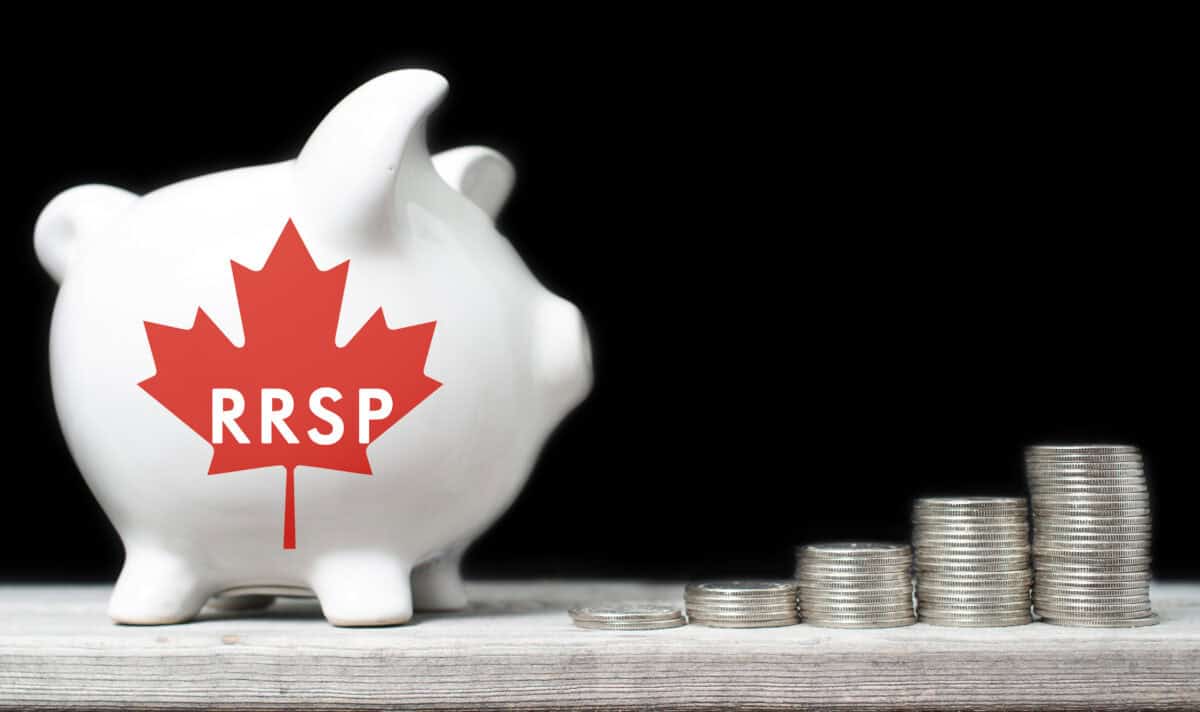
That doesn’t make a Registered Retirement Savings Plan (RRSP) a bad retirement account. Far from it. Contributions can reduce taxable income while investments compound tax-deferred for decades.
The problem comes when almost every retirement dollar ends up in one. Eventually, withdrawing your own money can start determining how much tax you pay and even how much Old Age Security (OAS) you keep.
Source: Getty Images
Tax later
RRSP withdrawals are generally taxable income. That may work beautifully if you’re contributing while paying a high marginal tax rate and withdrawing at a substantially lower one in retirement. Yet the balance can become surprisingly large after decades of compounding.
Then age 71 arrives. An RRSP must mature by the end of the year you turn 71. Many Canadians transfer it into a registered retirement income fund (RRIF), where minimum withdrawals begin the following year. At age 72, the current minimum factor is 5.4%. A $1 million RRIF would therefore require a minimum withdrawal of about $54,000.
Add the Canada Pension Plan (CPP), Old Age Security (OAS), a workplace pension, or other taxable income and suddenly retirement can produce considerably more income on paper than you’re actually spending.
Flexibility matters
That becomes important because the estimated 2026 OAS recovery tax threshold starts at $95,323 in net world income. TFSA withdrawals work differently. Eligible investment income and withdrawals generally remain tax-free and don’t affect federal income-tested benefits, including OAS.
That’s why I like building more than one retirement source. Someone with sufficient contribution room might contribute to an RRSP during higher-income years, while also investing inside a Tax-Free Savings Account (TFSA). Later, having both taxable and tax-free money can provide considerably more control over where retirement income comes from. Then the investments inside those accounts still need to grow.
TD
One I’d consider is Toronto-Dominion Bank (TSX: TD). TD operates Canadian and U.S. banking businesses alongside wealth management, insurance, and capital markets. Its U.S. anti-money-laundering remediation remains a major job, but the underlying businesses are producing increasingly strong results.
Third-quarter adjusted earnings per share (EPS) climbed 26% year over year to $2.77. Canadian personal and commercial banking delivered record earnings, while U.S. Banking adjusted earnings rose 11% in U.S. dollars. TD’s Common Equity Tier 1 (CET1) ratio, a key measure of a bank’s capital cushion, also stood at a healthy 14.3%.
The bank currently pays $1.12 per share quarterly, or $4.48 annualized. At $172.71 at writing, that’s a yield of roughly 2.6%. That isn’t enormous compared with some Canadian dividend stocks, yet TD offers the combination I’d rather compound for decades. That’s earnings growth, dividend income, and a strong capital position.
Bottom line
TD still has work ahead. Its U.S. anti-money-laundering remediation involves substantial spending, regulatory oversight, and execution risk through 2027 and potentially beyond. The shares have also rallied strongly, so today’s valuation offers less room for disappointment than investors had a year ago.
Still, the bigger retirement lesson isn’t that everyone needs TD. It’s that where investments compound can eventually matter almost as much as what you own.
In short, I’d happily use an RRSP, particularly when the deduction saves substantial tax today. I just wouldn’t make it my only retirement account. A large RRSP is a wonderful problem to have. However, a large RRSP alongside tax-free savings is better, because future you gets something increasingly valuable as retirement approaches: options.