Higher interest rates can make buying property feel like an increasingly expensive choice. Owning a small piece of a property business is much more manageable. You don’t need a down payment, and somebody else handles the tenant calls.
The timing doesn’t look great, though, which helps explain the opportunity. Many expect the Bank of Canada to raise its policy rate this Wednesday. Meanwhile, property stocks often struggle when borrowing becomes more expensive. A reliable rent cheque can become less fashionable surprisingly quickly.
For someone building monthly investment income, that creates a reason to look carefully. The good businesses still collect rent when investors are worrying about interest rates. Buying one at a sensible price can put those payments to work in your own account.
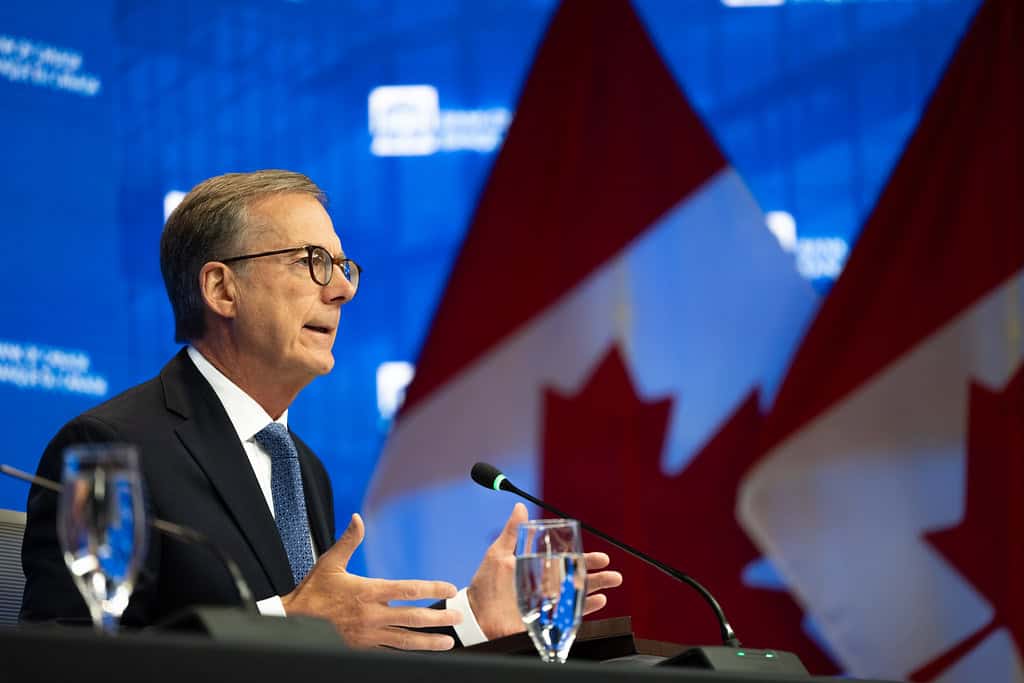
Governor Tiff Macklem; Source: Bank of Canada
Start with rent
A real estate investment trust (REIT) owns properties and passes some of the income to investors. Its tenants pay rent, the trust pays its expenses, and shareholders receive distributions. The monthly payment is appealing because it fits neatly beside monthly household bills.
Higher rates can squeeze that arrangement when old debt needs refinancing. They don’t usually reprice every loan immediately. Growing rents and well-spaced borrowing deadlines can give a trust time to manage the change. That makes the quality of the properties and leases especially useful now.
A rate increase also creates competition for your savings. If a deposit pays more, a property investment has to offer enough income and growth to justify its fluctuating price. Granite’s attraction is the possibility of rising rent over time. You’re buying a share of that earnings power, with monthly cash arriving along the way.
Granite REIT (TSX: GRT.UN) owns warehouses, logistics facilities, and other industrial properties across North America and Europe. These buildings support the movement and production of goods. A retailer can sell online, but the products still need somewhere to sit before reaching the customer.
A payment with room behind it
Granite’s current monthly distribution is $0.30 per unit. At a recent share price of $84.43, that works out to about 4.2% annually. Here is what a $10,000 budget buys before trading fees.
| COMPANY | RECENT PRICE | NUMBER OF SHARES | ANNUAL DIVIDEND | ANNUAL TOTAL PAYOUT | FREQUENCY | TOTAL INVESTMENT |
|---|---|---|---|---|---|---|
| GRT.UN | $84.43 | 118 | $3.5496 | $418.85 | Monthly | $9,962.74 |
That’s about $34.90 a month, with $37.26 left in cash! There is a reassuring amount of room behind that cheque. Granite generated $1.26 per unit in adjusted funds from operations (AFFO) during the second quarter. That’s a property cash-earnings measure that allows for recurring costs. Three current monthly payments total about $0.89, using roughly 70% of those earnings.
Into November
That cushion gives Granite room to maintain properties and absorb some pressure before the payment becomes stretched. It also makes the yield more interesting than a higher payout that already consumes virtually everything the business earns.
The price works out to roughly 17 times annual cash earnings if the latest quarter’s pace continues. I see a reasonable entry point for a long-term income holding, with enough business quality to consider buying gradually. After all, it isn’t a promise that the units will rise after Wednesday’s announcement.
Higher financing costs and a tenant leaving are the risks I’d take seriously. A diversified portfolio leaves room for either problem without making one warehouse owner’s bad quarter your household’s bad quarter. A Tax-Free Savings Account (TFSA) can shelter the Canadian tax on suitable holdings when you have room.
Bottom line
Granite reports after the market closes November 4. Growing rent and another comfortably covered payment would strengthen the reason to own it. I like the chance to collect income while the business grows, especially when rate worries are giving investors a reason to overlook the buildings doing the earning.