There is chaos in global stock markets. The Russia-Ukraine war has indirectly impacted Europe and the U.S., which depend on Russia for commodities like oil, natural gas, and uranium. But the western countries took a bold step and imposed sanctions on Russian oil and natural gas. Now, Russia is reportedly considering banning uranium supply to the United States. This war and the resulting sanctions disrupted the global supply chain and boosted commodity prices. All this uncertainty has made Canada an attractive avenue for risk-averse investors.
Three reasons to invest in Canada
- Oil prices
- Uranium prices
- House prices
Canada benefits from rising oil prices
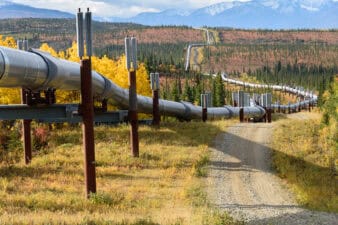
Canada has the world’s third-largest oil sands reserves. It is the fifth-largest oil producer after the U.S., Saudi Arabia, Russia, and Iraq. At present, Russia and Iraq face sanctions, and a missile attack on Saudi Arabia’s fuel depot has raised fears of supply shortage. This has made Canada a peaceful and stable alternative for oil.
Canada supplies 99% of its oil production to the United States. To look at it the other way, the U.S. imported 51% of its gross petroleum imports from Canada in 2021. In all permutations and combinations, Canada is the next oil destination. You can get exposure to this oil rally by investing in Canada’s largest oil companies, Canadian Natural Resources (TSX: CNQ)(NYSE: CNQ), Suncor Energy, and Cenovus Energy.
Canadian Natural Resources primarily has operations in Western Canada and is exploring opportunities in offshore Africa and the United Kingdom. The stock surged 18% since the war broke out and could rise further with increasing oil prices. The company is sharing windfall gains with its shareholders; it increased dividends twice this year, by 25% and 28%. More dividend growth could come throughout the year as the supply situation remains tight.
Canada and uranium
Another natural resource few consider is uranium. Canada is the fourth-largest producer of uranium from mines, while Russia is in seventh place. The U.S. imports 16% of its uranium needs from Russia. Amid the war and sanctions, the U.S. is looking for alternative suppliers. Canada could be a feasible supplier given the trade relations the two share and the proximity. You can get exposure to Canada’s uranium opportunity by investing in Cameco (TSX: CCO)(NYSE: CCJ), Denison Mines, and NexGen Energy.
Cameco is the world’s second-largest uranium producer, accounting for 18% of the world’s production. The stock has surged 37% since the war broke out. The growing tensions in oil-rich countries and the rising awareness of carbon emissions encouraged many countries to accelerate their green energy initiatives.
While nuclear is not renewable energy, it is a carbon-free energy source that is not affected by climate conditions, like wind and solar. At present, 10% of world energy production comes from nuclear energy. This ratio won’t change anytime soon. But in the next 30 years, uranium could be a viable energy fuel. Utilities might sign long-term supply contracts with uranium miners.
House prices
Canada’s house price jumped by a record 26.6% in 2021. In February 2022, the average home price was up 20.6% year over year to $816,720. This growth was fuelled by record low-interest rates. However, this growth is likely to slow as Canada’s central bank follows the U.S. Federal Reserve and increases its interest rate to an estimated 2%.
Economists are divided over Canada’s house prices. Some expect a 24% correction while some expect slower growth. RBC Economics expects house prices to grow by 6.2% in 2022 and 3.2% in 2023 as mortgage rates increase.
Even though there is a risk of a housing bubble, Canadian REITs with mixed-used properties pose an attractive investment. They give you exposure to residential, commercial, and retail properties. SmartCentres REIT (TSX: SRU.UN) gives you indirect exposure to house prices with its SmartLiving project. The REIT surged 21.5% in a year to its pre-pandemic level. Although there is not much scope for capital appreciation, it offers a 5.6% dividend yield.
Investor takeaway
Investors need certainty in these uncertain times. Hence, Canada is an attractive investment opportunity.