America, Canada’s biggest export customer, has threatened a trade war, causing a steep correction in the TSX. While they say that Prime Minister Justin Trudeau and the U.S. president talks have paused the tariffs for 30 days, things have surely become uncertain. On one side, Trump, referring to Canada, says, “We don’t need anything they have.” On the other side, Trudeau is retaliating by pushing a “Buy Canadian” campaign to reduce the impact of dollar-to-dollar tariffs.

Image source: Getty Images
How long will the U.S.-Canada trade war last
The trade figures are in America’s favour. Only 17% of U.S. exports go to Canada, whereas more than 75% of Canadian exports go to the U.S., according to U.S. government data. The largest commodity exported from Canada is oil and gas.
The threat of a 10% tariff on Canadian oil and a 25% tariff on other goods has encouraged Canadians to retaliate. You can see Canadian firms cancelling contracts with U.S. firms and Canadian stores removing American beer and whiskey from the shelves.
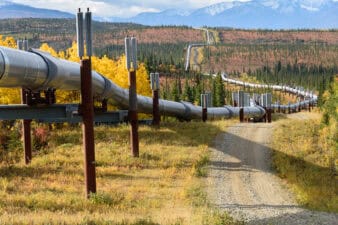
For Canada, tariffs are more than just higher prices for goods. It exports 99% of its oil to the United States, which accounts for about a fifth of Canada’s gross domestic product (GDP).
After the first round of talks between Trump and Trudeau, it’s been stated that Canada misunderstood the tariffs as a trade war and that the U.S. only wants Canada to reduce immigrants and drugs entering the country.
The effects of the trade war will gradually unfold as more such talks are held. The 2018 trade war lasted a year, after which both countries agreed on a settlement. BMO Capital Markets estimates that a year-long tariff could reduce Canada’s GDP growth to nearly zero in 2025, leading to a mild recession.
Two sectors that could take a big hit in the U.S.-Canada trade war
Oil and gas sector
The Canadian oil and gas sector could see a downturn. A 10% tariff on crude oil could make Canadian oil expensive, and customers stressed by higher prices might pull back their demand. Oil companies like Suncor Energy (TSX: SU) and Cenovus Energy could face a demand shortage as oil and gas exports fall. Oil and gas pipeline companies like Enbridge and TC Pipelines could also feel the pressure with lower volumes transmitted from their pipelines. Their stock price could fall in the short term.
If we look at Trump’s energy policy to drill more oil wells, America is looking to become self-sufficient in its oil needs. It is also looking to export oil, which means Canada’s biggest oil customer may no longer need Canadian oil. As the global scenario unfolds unpredictably, it is better to prepare for every scenario.
Some economists argue that instead of bearing the economic costs of retaliation that may not be productive, Canada could focus on finding new markets for its oil and gas. This could reduce its dependence on America. Thinking out loud, Canada is already looking to export natural gas to Europe. This relation could be extended to oil, too, as Europe no longer has access to Russian oil.
This whole change in energy supply chain dynamics means difficult times for Canadian oil and gas companies for the coming two years till the matters settle. You could consider selling these stocks and instead buying Descartes Systems, which could help companies adjust to supply chain disruptions.
Automotive sector
The automotive sector could plunge to a new low. Already, the sector has been suffering from falling demand amid high interest rates that made cars expensive. A vehicle is assembled using components that are imported. If the cost of these imports rises, cars will become even more expensive in a falling GDP, reducing demand further.
The recovery of Magna International stock will be delayed until the situation stabilizes. Also, Trump’s decision to end the electric vehicle (EV) mandate could hurt Magna’s secular growth trend of EVs. Hence, it is better to stay away from automotive stocks in the current market environment.