A maturing guaranteed investment certificate (GIC) comes with a powerful temptation: do absolutely nothing.
The bank already has your money. The renewal offer lands in your inbox and rates look respectable again. A few clicks later, your cash disappears behind another five-year lock without ever having to make an actual investing decision.
That convenience has become more tempting as bond yields have pushed higher. The Bank of Canada has kept its policy rate at 2.25%, yet longer-term market rates have risen. Some five-year GIC offers are now around 4.25%.
For money you absolutely can’t afford to lose, that’s a pretty attractive deal. For money you won’t need for another decade, I wouldn’t automatically take it.

Source: Getty Images
Safe isn’t enough
A GIC gives you something stocks can’t: certainty. Hold a non-redeemable GIC until maturity and you know what your principal and interest should look like at the end. That makes GICs useful for a home down payment, upcoming retirement spending or any goal where a stock market selloff could ruin your timing.
The problem begins when investors confuse “safe” with “best.” Lock $10,000 into a five-year GIC at 4.25%, and it could grow to roughly $12,315 if interest compounds annually. Nothing wrong with that. Yet inflation will nibble away at some of the purchasing power, and your upside stops at the agreed rate.
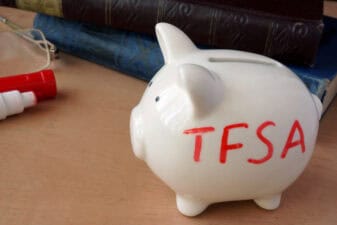
That opportunity cost becomes much more important when you’re investing inside a TFSA. Interest, dividends and capital gains can all grow tax-free in the account, provided you stay within your available contribution room. So if the GIC is maturing inside a TFSA and the money won’t be needed for years, I’d at least ask whether part of it deserves a longer runway.
Buy the bank
Bank of Montreal (TSX: BMO) offers an amusing alternative. Your bank may be perfectly happy to sell you another GIC. You could instead consider owning a small piece of the bank collecting all those deposits.
BMO operates Canadian and U.S. personal and commercial banking businesses alongside wealth management and capital markets. Its Bank of the West acquisition gave it a much larger U.S. footprint, although making that expansion more profitable remains one of management’s biggest jobs.
Recent results suggest the machinery is moving in the right direction. BMO’s third-quarter adjusted earnings per share climbed 22% year over year to $3.96. Its Common Equity Tier 1 ratio, which measures the capital cushion available to absorb losses, remained a healthy 13%.
The bank also pays a quarterly dividend of $1.71 per share, or $6.84 annually. At a recent price around $235, that works out to a yield near 2.9%. Yes, that’s lower than a good GIC rate, but isn’t necessarily a problem. Unlike GIC interest, a dividend can increase. The company can also grow earnings, repurchase shares and become more valuable over time. That combination is why strong Canadian dividend stocks make more sense for money with a long enough horizon.
What a decade can do
BMO traded around $85.83 in early October 2016. At roughly $235 today, its share price has increased at an annualized rate of about 10.6%, even before including dividends. If that historical rate continues, and there’s absolutely no guarantee it will, the difference becomes substantial.
| STARTING AMOUNT | ASSUMED ANNUAL GROWTH | AFTER 5 YEARS | AFTER 10 YEARS |
|---|---|---|---|
| $10,000 | 10.6% | $16,563 | $27,434 |
That isn’t a forecast, but BMO has already enjoyed a powerful run, including a gain of more than 30% this year, so expecting another identical decade would be asking quite a lot. That brings us to the catch.
BMO trades around 14.5 times forward earnings, so investors aren’t exactly finding it in the bargain bin. Its U.S. business still needs to deliver stronger returns, while a Canadian slowdown could increase credit losses.
Bottom line
A roughly 4.25% guaranteed return deserves consideration, especially when protecting principal matters more than maximizing growth.
Yet a five-year renewal is still a five-year decision. If your goal sits much further into the future, locking every dollar away could mean protecting yourself from volatility while also protecting yourself from considerably more upside.
BMO won’t provide a guarantee. Over a decade, however, growing earnings, dividends and share value give it something a GIC never will. That’s room for the return to get bigger.