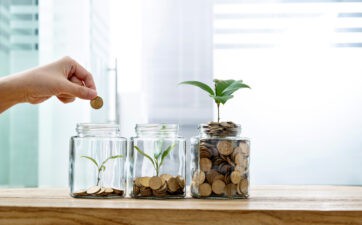
A dividend can disappear into a takeout order so efficiently you’d swear it never arrived. I’d enjoy the occasional dinner. Yet if I’m still building the account, I’d give those cheques a chance to buy something that can pay me again.
Source: Getty Images
Count the money once
Reinvesting means buying more shares with the cash your existing shares earn. Those new shares can produce dividends of their own. When you repeat it for years, some of your future income comes from money the portfolio earned, without another deposit from your paycheque.
Suppose my existing holdings generate an average of $200 a month, or $2,400 a year. I’d collect the payments and invest the cash on a regular schedule. If the dividends are quarterly, I can wait for the cash to arrive or use an existing reserve to smooth out my purchase dates.
In the following example, I keep the original holdings separate and count their $200 a month as the money flowing into the new investments. Those new investments earn an assumed total return that includes any dividends they pay and reinvest. Adding a yield to that return would count the same income twice.
CPKC
Canadian Pacific Kansas City (TSX: CP) is a stock I’d consider for some of that cash. It moves freight across Canada, the United States and Mexico. I’d be looking for businesses to use more of its cross-border network so the railway can earn more from the lines and equipment it already runs.
CPKC’s third-quarter revenue rose 15%, while higher fuel prices hurt its operating ratio, which shows how much revenue goes to operating expenses. I’d watch that gap. Revenue can grow fast and still leave less of each dollar available for the spending and dividends I’m counting on.
Its latest quarterly dividend was $0.27 per share, up from $0.23 before the 2026 raise. At the recent close of $129.97, that works out to a yield of about 0.8%. That small cheque makes sense for this job if the railway can keep growing profit per share and I don’t need to spend the income today.
A single $200 deposit could buy one share at that price and leave $70.03 before fees. I’d keep the change for the next purchase or wait until I have enough cash to buy more efficiently. I’d therefore rotate into other businesses rather than direct every dividend to the railway.
Looking ahead
Here’s the value of a separate account that starts at $0 and gets $200 each month-end. The rates assume annual total returns with monthly compounding and no fees or taxes. The last column shows what the final balance could pay at an illustrative 4% portfolio yield.
| ANNUAL TOTAL RETURN ASSUMED | VALUE AFTER 10 YEARS | ANNUAL INCOME AT 4% |
|---|---|---|
| 0% | $24,000 | $960 |
| 4% | $29,339 | $1,174 |
| 6% | $32,495 | $1,300 |
| 8% | $36,025 | $1,441 |
The new income would sit beside the existing $2,400 if the original holdings still paid the same amount. At 6%, that’s roughly $3,700 combined, or $308 a month on average. The 4% yield applies to the eventual mix of holdings. I’m not assuming the railway suddenly pays that much. Instead, I’d write down the rate I actually earn every year or two and compare it with the example.
Freight demand can weaken, and higher costs can reduce what the railway keeps from each shipment. Build compound growth across several industries and use the cash from my Canadian dividend stocks to add wherever the price makes sense.
Bottom line
Give the first $200 the job of earning another cheque. Do that often enough and the account can start funding purchases you once had to squeeze out of the household budget.