Enbridge (TSX: ENB) stock has dipped 15% from its July 2026 high as the company’s leverage ratio crosses its targeted 4.5–5.0 times. The company’s $3 billion equity financing has investors worried about the dilution. It’s not just Enbridge, but every utility and energy infrastructure stock in Canada. They are all seeing increasing capital spending funded by debt. Behind the push is Canadian Prime Minister Mark Carney’s infrastructure boom.
Enbridge reinvests capital in the business if it sees opportunities for growth and expansion. A majority of its US$39 billion capital spending is self-funded: $5–$6 billion from free cash flow before capex and $5 billion from additional debt capacity as it repays that much debt.

Source: Getty Images
Are Enbridge’s dividends safe?
These are uncertain times. Many dividend kings have slashed their dividends owing to rising debt and capital expenditure needs. If not slashed, they have slowed dividend growth. This has pushed investors to safer dividend stocks. And when we talk about safe dividends, Enbridge is the first name that comes to mind. It is among Canadians’ favourite retirement stocks.
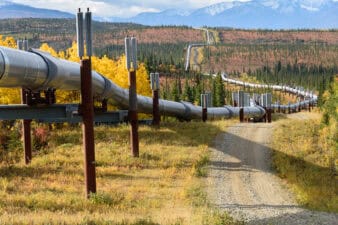
Even now, as Enbridge’s debt surpasses $100 billion and capex crosses its historical peak, its dividends are safe. Dividend safety is assured by its low-risk model. The company supplies oil and gas from the exploration site to refineries and from refineries to the end market. Its key source of earnings is transportation services.
While you may see commodity sales, Enbridge mostly works as the middleman, where it doesn’t process or mine commodities. It stores commodities and distributes them, which reduces its risk from energy price fluctuations. But what if the demand falls? Enbridge hedges this risk with take-or-pay contracts. If a customer signs the supply contract, they have to pay whether or not they use the commodity. This assures earnings if every new pipeline is in use.
Scheduled maintenance and outages could affect its earnings. Thus, it only pays 65% of its distributable cash flow (DCF) as dividends to shareholders. The DCF is the amount left after deducting financing and maintenance costs from adjusted Earnings Before Interest, Taxes, Depreciation, and Amortization (EBITDA).
Enbridge has been successfully running its business for more than 75 years and has put in place a business structure that can manage most risks. Its experience and scale give it an edge over other pipeline operators.
The Enbridge dividend uncertainty
Today, if you invest $6,000, you could buy 88 shares of Enbridge for $68 per share. The record date to receive the fourth-quarter dividend was November 13. You will be eligible for 2027 dividends. There is a conundrum here.
Either Enbridge may retain its 3% dividend growth rate for 2027–2030 or accelerate it to 5%, as it guided 5% DCF growth from 2027 onwards. Five percent DCF growth does not translate to 5% dividend growth, as it is at management’s discretion to determine the payout ratio. It can be anywhere between 60% and 70% of DCF.
A 3% dividend growth might keep the payout ratio at 64.7%, and 5% dividend growth might increase it to 67%. With the new CEO taking over from January 1, 2027, it is difficult to say how the dividend will grow moving forward.
Here’s the dividend $6,000 would collect
If we take both scenarios, a $6,000 investment today could give you $352–$359 in annual dividends. This dividend could grow to $384.30 to $415 by 2030.
| Stock Price | Year | Enbridge shares purchased from $6,000 | Dividend per share @ 3% CAGR | Dividend | Dividend per share @ 5% CAGR | Dividend |
| $68.00 | 2026 | 88 | $3.88 | 0 | $3.88 | 0 |
| 2027 | $4.00 | $351.68 | $4.07 | $358.51 | ||
| 2028 | $4.12 | $362.23 | $4.28 | $376.44 | ||
| 2029 | $4.24 | $373.10 | $4.49 | $395.26 | ||
| 2030 | $4.37 | $384.29 | $4.72 | $415.02 |